Shmiras halashon (1 halacha a day)
Filtered WhatsApp · Special Edition
tap for pinned, media and shiurim
Nesanel Devor
Thu, Jun 4 5:29 PM
Day 72. Rechilus: It is forbidden to repeat Rechilus even if you are being pressured.
Avroham
Sun, Jun 7 9:33 PM
Day 73. Rechilus: What is the Halacha in the following case: Someone asks you what someone else said about him and the response may contain negative information. If it’s possible to answer truthfully without repeating the negative information, then you are required to do so. However, if this is not possible, then it is permissible to lie for the sake of peace.
Nesanel Devor
Mon, Jun 8 5:47 PM
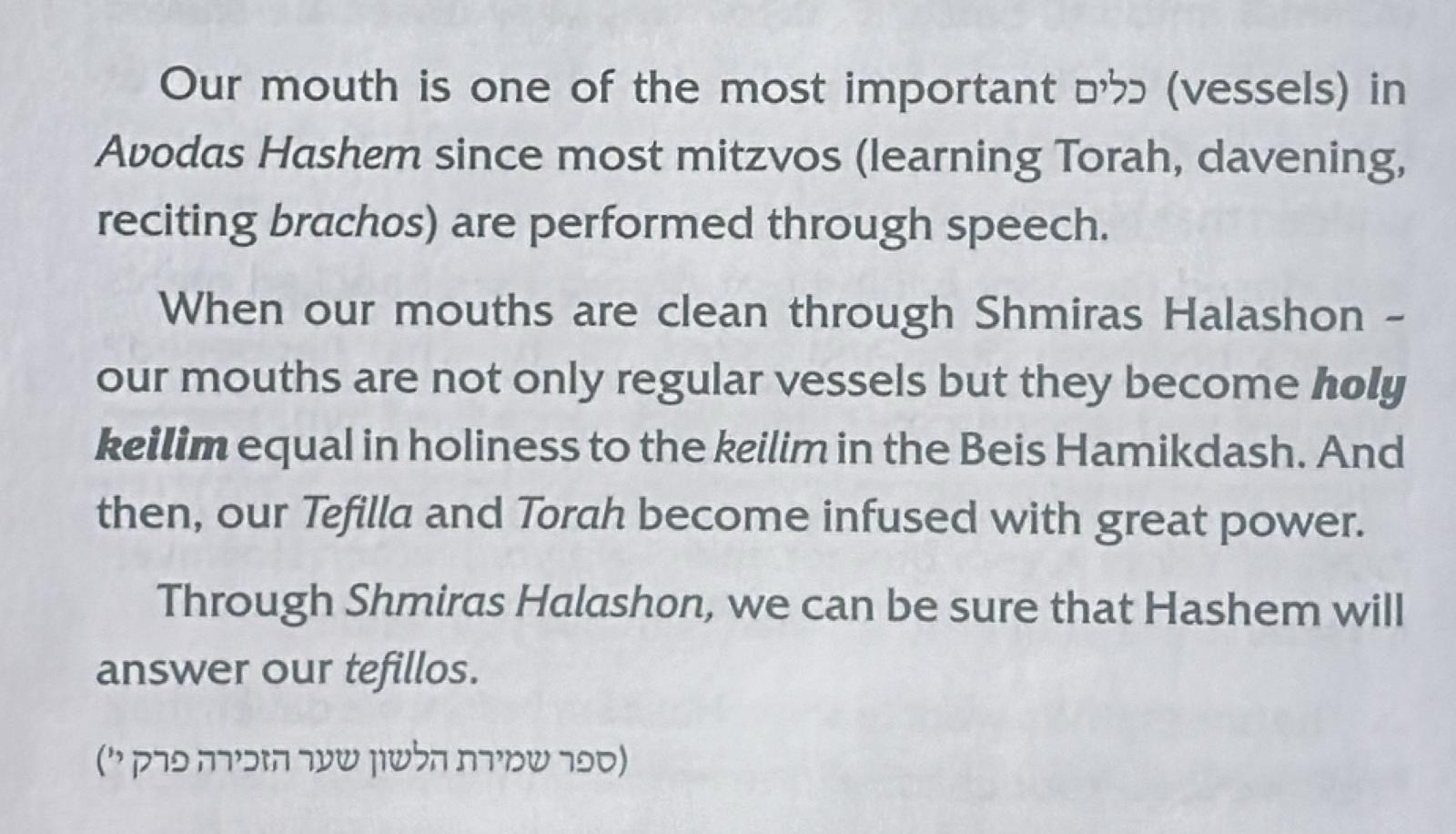
Day 74. The chofetz Chaim on when we guard our speech:
Avroham
Tue, Jun 9 3:04 PM
Day 75. Avak Rechilus: Statements which do not contain outright negative information, yet nevertheless cause ill feelings fall under the category of Rechilus. For example: you tell your brother, “ yesterday when I mentioned your name to our neighbor, he said, ‘I don’t even want to talk about him”. Since this statement can cause your brother to feel hurt, it is forbidden.
Nesanel Devor
Wed, Jun 10 9:33 AM
Day 76. Avak Rechilus: Sometimes by praising someone, one can cause ill feelings. Example: Reuven and Shimon are partners in business. You tell Reuven “Your partner Shimon is so generous, last week he lent me $100,000 from the business.” Why is this forbidden you may ask? Because it can cause Reuven to be upset with Shimon for lending so many much money without his consent. It is also forbidden to repeat to another yid that someone praised him in a manner which can cause ill feelings. For Anothe
…Avroham
Fri, Jun 12 2:43 PM
Day 77. Avak Rechilus: It is forbidden to repeat a statement which people may be sensitive to, even though it is not negative. Example: your sister went on vacation, she left her children by a neighbor for a week. At a Later date, you tell your sister, “your neighbor told me she had a very hard week and wasn’t up to having your children.” Although the neighbor didn’t say anything negative, it is forbidden. Why? Because it might cause your sister to feel hurt by your neighbor.
Nesanel Devor
Sun, Jun 14 4:20 PM
Day 78. Avak Rechilus: Repeating a statement that can be interpreted in both a positive or negative way may fall under the category of Avak Rechilus . Example: Your neighbor tells you, “You know your mother is always cooking”. This statement can be interpreted negatively- your mother is very food minded. However, this statement can also be interpreted positively. Your mother always has guests and therefore she needs to prepare food. Are you permitted to repeat this statement to your mother? If
…Avroham
Mon, Jun 15 12:18 PM
https://chat.whatsapp.com/Fe75sDSkGMt2IYLjAWDFCQ?s=sw&p=i&ilr=0 For more videos and pictures like this join @33793138286686 chat 😄🔥🔥
Nesanel Devor
Tue, Jun 16 2:56 PM
Day 80. Rechilus: It is forbidden to repeat negative information even without mentioning who said it If the person will figure out who the speaker was. Example: You tell your friend, “Someone told me you played horrible in that basketball game yesterday”. Your friend will assume it’s Mr. so and so since he was the only one at the game that knew him.
Avroham
Wed, Jun 17 11:16 PM
Day 81. Rechilus: It doesn’t make a difference to whom you are saying Rechilus. It is forbidden to relate Rechilus even to one’s family members. For exampleIf if someone talked negatively about your mother or father it is forbidden to repeat it to them, even if you are trying to protect them. It is also forbidden to relate Rechilus to a child.
Nesanel Devor
Thu, Jun 18 1:50 PM

Day 82:
Avroham
Sun, Jun 21 8:39 PM
Day 83. Rechilus: It is forbidden to speak Rechilus to the relatives of the person who was spoken about. Why? Because the nature is that a person will bear a grudge against those who embarrass members of their family. Thus, it would be forbidden to tell a woman/man that someone spoke negatively about their spouse. It would also be forbidden to tell a parent that someone spoke negatively about their child. It would be forbidden to tell a sister/brother that someone spoke negatively about their si
…Avroham
Mon, Jun 22 6:10 PM
Day 84. Rechilus: If a talmid chacham speaks negatively about someone it is forbidden to repeat it And it’s even worse than regular Rechilus. Why? • Because it is quite rare that a talmid chacham would speak against someone without a constructive purpose. Thus, by blaming a talmid chacham for speaking negatively, one is in essence lying. • Our Torah instructs us to support the talmidei chachamim and to give them honor. It is therefore really bad to cause someone to bear a grudge against them. •
…Nesanel Devor
Tue, Jun 23 11:58 PM
Day 85. Rechilus: It is forbidden to talk Rechilus about a child. Example: “You see 10 year old reuvan being mean to your friends son”. You then tell your friend, “I saw reuvan being mean to your son”. This is forbidden. You may claim that you are doing a mitzvah by defending the child, However…… The Chofetz Chaim writes, “such a remark can lead to the most devastating atrocities. If one would try to figure out how many issurim can be transgressed, It would be too numerous to count”. What can
…Avroham
Thu, Jun 25 1:26 AM
Day 86. Preventing Rechilus: Refrain from asking people “what did he/she say about me?” If there is a strong chance that the response may contain negative information.
Nesanel Devor
Fri, Jun 26 12:30 PM
Day 87. Is It Rechilus?: If we implement the advice of the ramban to think before we speak, we will be saved from the grave danger of Rechilus. What should we think? How can we judge if a statement is rechilus? We must ask ourselves before speaking “will my words cause ill feelings to be aroused between two yidden”.
Avroham
Sun, Jun 28 6:58 PM
Day 88. Teshuva for Rechilus😬: •One must feel regret for speaking rechilus. •One must confess to hashem that he said over Rechilus. •One must take upon oneself not to talk Rechilus in the future. •One must ask forgiveness from the person of whom he spoke😬😬😬
Nesanel Devor
Mon, Jun 29 1:09 PM

Day 89.
Avroham
Tue, Jun 30 11:22 PM
Day 90. Toeles: Toeles is speech which is negative but permissible to relay for constructive purpose only. We will start to learn the conditions and halachos of toeles tomorrow iyh.
Avroham
Wed, Jul 29 5:52 PM
Day 105. Believing Loshon hara: Believing Loshon hara is forbidden even when the person who is being spoken about is right there and doesn’t deny it. How can you not believe it? What should you think? Maybe this person is working on the middah of keeping quiet when others embarrass him🤷🏼♂️🔥
Nesanel Devor
Thu, Jul 30 11:57 AM
Day 106. Believing Loshon Hara: Believing Loshon Hara is forbidden even if it is so well known that it is printed in the newspapers.
Avroham
Sun, Aug 2 2:41 PM
Day 107. Believing Loshon hara: - If a parent speaks Loshon hara, you may not believe it. (Same goes for anyone who would be considered trustworthy) - If a child tells you Loshon Hara, you may also not believe it. Although, you may investigate the matter on the chance it may be true, but you may not believe it as fact.
Lenny Devor
Mon, Aug 3 5:51 PM
Day 108. Listening to Loshon Hara: When is it permissible to listen to loshon hara? When the information can have an effect on you or someone close to you in the future. For Example: when you are inquiring about a shidduch or a partner of business. In this case the Halacha is as follows: If you are the one who is asking information, you must explain the reason why you’re asking. Meaning, when you ask, be clear as to what you’re asking for and not just casually asking about negative information.
…Avroham
Tue, Aug 4 4:21 PM
Day 109. Listening to loshon hara: There is another instance where you are allowed to listen to loshon hara, when somebody is expressing/ unburdening themselves to you🤯. The Halacha is you are allowed to listen but not believe the information. You are actually doing a mitzvah by listening. How? - You are relieving someone’s pain by listening. - By listening you are calming the person down and preventing the person to tell more people about it.
Lenny Devor
Wed, Aug 5 6:15 PM
Day 110. Listening to Loshon Hara: What is the Halacha in the following case? Your friend starts talking to you about someone, how should you know whether or not you’re allowed to listen? How should you know whether or not the information is relevant to you? For example - Your friend tells you, “your neighbor is a bit….” If you suspect that it might be Loshon Hara, you must ask right away, “is the information important for me to know?” If your friend says “yes” then you could listen, but not bel
…Avroham
Sun, Aug 9 7:11 PM
Day 111. Listening to Loshon hara: What is the case if you didn’t initially realize that your friend will be saying Loshon hara to you and you hear what he says. For example: your friend tells you “you know my neighbor is so self-centered. She would never help me with my kids if I am late. You realize at the end of the sentence “uh oh, that was Loshon hara.” What should you do now? Try to find a zchus for that person. You can tell your friend something like, “I heard she’s been busy with her job
…Lenny Devor
Tue, Aug 11 6:29 PM
Day 112. Listening to Loshon hara: If you are sitting among a group and someone starts talking Loshon hara…. What are you required to do? The best thing to do is to stop the person. Obviously you should say it in a nice way and to make sure you don’t embarrass anyone. However, if you feel that you just can’t do that, then you should at least walk away or close your ears. If it is impossible to walk away or close your ears, then you should definitely: • not believe the Loshon hara • not enjoy the
…Lenny Devor
Wed, Aug 12 5:24 PM
Day 113. Listening to Loshon Hara: If a group is already speaking Loshon Hara and one comes over purposely in order to listen, or one finds company with people who habitually speak Loshon Hara, such a person is called a “posheia”. In the will of Reb Eliezer hagadol, he writes to his son: “Keep away from groups who tend to speak Loshon Hara for when Hashem writes down the conversations in the sefer hazichronos, all the participants will be given a terrible name, חבורת רשע- A group of evil 😨. The
…Lenny Devor
Mon, Aug 17 4:58 PM
Day 114. When someone talks negatively about himself, it is permissible to believe him, yet you may not pass the information further.
Avroham
Tue, Aug 18 7:00 AM
Day 115. When is it permissible to believe loshon hara: When a trustworthy person talks about a person’s negative behavior for a constructive purpose, it is permissible to believe him if the following conditions are met. • The speaker is as trustworthy as 2 witnesses in beis din (not sure how we determine that) • The trustworthy person saw the negative behavior in person. •If there is any way to be Dan lchaf zchus the persons behavior, you are to do so. BE VERY CAREFUL: In the event that all of
…Lenny Devor
Tue, Aug 18 2:47 PM
Day 116. When is it permissible to believe Loshon Hara?: When you see obvious signs that the Loshon Hara is true and you fulfill all the requirements below, then you may believe the Loshon Hara. However, since there are many conditions that must be met, it’s best to avoid relying on this. These are the conditions: •The obvious signs must be closely related to the information. • You have to have seen the signs yourself. •This heter only applies if the information will have an effect on you in the
…Nesanel Devor
Wed, Aug 19 10:46 PM
Day 117. Dan L’kaf Zchus: The mitzvah of judging others favorably safeguards and prevents a person from speaking negatively about others. Do we always have to be Dan L’kaf Zchus? Great question! It depends on the person and the situation. We will discuss 3 different categories. •The Tzadik - A righteous person who is always careful in mitzvos. •The Beinoni - Who is sometimes careful and sometimes not. •The Rasha - Will discuss who falls under that category…. Halachos of how to judge each categor
…Nesanel Devor
Sun, Aug 23 6:40 PM
Day 120. Dan L’kaf Zchus: If a person is a “Rasha” then you are not required to judge favorably, but nowadays we aren’t sure who really falls under that category. People nowadays are considered “Tinok Shenishba” and we are still required to judge favorably.
Nesanel Devor
Mon, Aug 24 5:14 PM
Day 121. Conclusion🤩🤗: The Chofetz Chaim concludes his Sefer by saying that one should cautiously measure his words. One should make sure that his words are accurate and comply with Halacha. Then, the Chofetz Chaim promises “One who fulfills these instructions will merit a great reward and Hashem will rescue you from the traps of the Yetzer Hara. This is literally incredible! This is the 4th time around 🤯. Thank you all for learning with us on how to use our speech properly and let’s keep on
…Nesanel Devor
Mon, Aug 24 5:18 PM
https://chat.whatsapp.com/HJwQICdAUdBImwDjnCCWdU If you’d like, we will be continuing so if you have any family, friends, relatives etc. who may like to join please feel free to share around.
Nesanel Devor
Mon, Aug 24 9:16 PM
Brachos beyond brachos. I can’t believe we made it to 900. Again thank you everyone.
Nesanel Devor
Thu, Aug 27 7:47 PM
Day 2. Causing Humiliation 😓: Speech which can cause another yid to be degraded in the eyes of his peers is Loshon Hara. Therefore, it is forbidden to talk negatively about someone’s inborn traits. You may claim, “I’m really not saying anything negative about the person because it’s not his fault that he was born this way.” The Chofetz Chaim reminds us, imagine if you were that person, How would you feel? Negative remarks about someone’s inborn traits is in a sense worse than negative comments
…Nesanel Devor
Fri, Aug 28 9:35 AM
Day 3. Causing Humiliation: The Chofetz Chaim begins his Sefer by stating that Hashem separated us from all other nations and gave us a beautiful present- The Torah, and then took us to eretz Yisroel. Why give us the Torah and bring us to eretz yisroel? so we can fulfill Hashems mitzvos. The Chofetz Chaim reminds us that the galus we are in is nearly 2,000 years old and throughout this long difficult galus we have been hoping and davening that moshiach will come soon, so why does it seem lik
…Nesanel Devor
Sun, Aug 30 10:37 AM
Day 4. Causing Humiliation: It is forbidden to talk negatively about someone’s appearance/ clothing even if it is obvious to all who see the person. If it’s so obvious, why am I not allowed to talk about it? Sick question! The Chofetz Chaim tells us, “put yourself in the persons shoes, how would you feel if you heard people talk about you in such a way?”
Nesanel Devor
Mon, Aug 31 2:56 PM
Day 5. Causing Humiliation: It is forbidden to talk negatively about someone’s family.
Nesanel Devor
Tue, Sep 1 6:22 AM
Day 6. Talking About Someone’s Actions/Traits: In the event that you see someone doing an aveira, it is forbidden to talk about it (even if it’s an aveira that you and most people aren’t careful with). Moreover, it is a mitzvah to judge them favorably. What should one think? • Either it was pikuach nefesh. • Or he wasn’t aware that he was doing an aveira. • Or he thought this mitzvah was a chumra (extra stringency) rather than chiyuv (obligation). • You can also assume the person did teshuva
…Nesanel Devor
Wed, Sep 2 9:40 AM
Day 7. Causing Humiliation: Just as it is forbidden to reveal that someone did an aveira, so too it is forbidden to discuss a persons bad middos, such as a strong temper, a lazy nature, stinginess etc. may we be zoicheh to work on how we portray people in a manner which can make them feel better ❤️🩹.
Nesanel Devor
Thu, Sep 3 9:08 AM
Day 8. Talking About Someone’s Actions: To say that someone spoke Loshon Hara is Loshon Hara 🤯. It is also Loshon Hara to reveal that someone didn’t extend kindness.
Nesanel Devor
Fri, Sep 4 3:59 AM
Day 9. Causing Humiliation: Although it is permissible to voice your disapproval of a general behavior, if you mention it in connection with a person/group, or it will be obvious about whom you are speaking about, then it is forbidden. If you state someone else’s disapproval about a person/ group, it is also Loshon Hara.
Nesanel Devor
Sat, Sep 5 4:06 PM

Tonight is the Chofetz Chaim’s yartzeit. Let’s daven for the Chofetz Chaim and ask him to help us in our everyday battles including on the way we speak.
Nesanel Devor
Sun, Sep 6 11:18 AM
Day 10. Causing Humiliation: It is forbidden to talk about someone’s past negative traits even though you are saying that the person changed for the better and does not have these traits anymore. Sometimes, you even mean to compliment the person, nevertheless it is forbidden. When is it permissible to reveal a persons negative actions? The Chofetz Chaim tells us that if we want to keep our children/students away from a bad influence then it would be allowed to talk about it. For Example: You tel
…Avroham
Mon, Sep 7 11:36 AM
Day 11. Causing Humiliation: It is forbidden to talk negatively about a rav or his psak. In a sense it’s worse than just regular Loshon hara, why? The Chofetz Chaim explains that besides for the sin of degrading the rav, you are also causing him to lose his authority (and potentially his livelihood). As a result, people will not value his words and may disregard his psak. Thus, your words can cause countless people to sin. (BTW…even if you don’t mention which rav it is, it is still forbidden).
Nesanel Devor
Tue, Sep 8 9:25 AM
Day 12. Causing Humiliation: It is forbidden to talk negatively about Rebbeim or Teachers. (This can specifically happen at school functions). It is forbidden for a child to talk negatively about his teacher or to imitate the teacher in a negative manner. If you hear a child talking negatively about a Rebbe/ Teacher, you must stop him. Now you may say “I understand you’re feeling this way towards your teacher but if he hurt or bothered you personally or you think he did something wrong and
…Nesanel Devor
Wed, Sep 9 1:39 PM
Day 13. Causing Humiliation: The Chofetz Chaim warns us that talking negatively about a speaker can have terrible ramifications. Besides for degrading the speaker, you are weakening the impact of a speech. Furthermore, as a result of your words, people will not be interested in hiring the speaker in the future. Example: You come home from a speech and someone asks you, “How was the speech?” (that question could be avak Loshon hara). It is forbidden to say the following statements: “It was much t
…Nesanel Devor
Thu, Sep 10 3:43 PM
Day 14. Causing Shame: Talking about another yid in a manner which can cause him shame (even though it is not necessarily degrading) is Loshon Hara. For Example: “Did you hear the song he sang? It was so off tune”. Or, “Did you see him in that basketball game, he played so bad”. Why do these statements fall under Loshon Hara? Isn’t it socially acceptable that most people do not excel in certain areas? That is a beautiful question. The above statements are Loshon Hara because the person being s
…Avroham
Fri, Sep 11 5:41 AM
Day 15🍎🍯 Causing shame: Sometimes a person is complemented, and you downplay the compliment. This is forbidden because it can cause shame to the person being spoken about. Example: “I don’t know why you are making such a big deal about him! He’s just a regular guy.” In the event that a person is chosen for an honorable position, it would be forbidden to express your disapproval.
Nesanel Devor
Fri, Sep 11 8:26 AM
We would like to personally thank everyone for such an incredible year! May you have an amazing rosh hashana and may you really connect to hashem and daven for this to be the best year ever! Remember, it’s not about asking for little, it’s about asking for much! May we be zoicha to continue this beautiful journey together and may we continue to get our tefillos accepted in the gates of Heaven❤️🩹.
Nesanel Devor
Mon, Sep 14 10:33 AM
Before we begin with the next Halacha, I hope everyone had a beautiful yuntif and really started the year off with a bang and got cleansed. With that….. Day 16. Causing Shame: It is forbidden to talk negatively about someone’s possessions or merchandise. This includes talking about businesses, services, and products. Example: “That restaurants food isn’t so good”, or “The clothing from that store doesn’t have good quality”. To say that a store is overpriced is also Loshon Hara. These things are
…Nesanel Devor
Mon, Sep 14 2:43 PM
Wow, wow, wow, wow. This is too surreal. Being able to learn with every single person on this chat everyday is unbelievably unreal. We hit over the 1,000 member mark 🤯. It’s truly a bracha and it means so much to us that we are all in this together. Thank you everyone!! ❤️
Yoni Fischer
Mon, Sep 14 3:05 PM
Yes - Amen Nesanel !!!! And I am sure I speak on behalf of everyone here - A tremendous amount of gratitude/ Hakaros Hatov to you Nesanel and Avroham for not only creating this chat but for consistently posting the Halachos of Loshon Hara for all of us !! It is truly a life changer besides being a life saver - השומר פיו ולשונו שומר מצרת נפשו ( one who guards their mouth guards their life ) ! Wishing everyone a גמר חתימה טובה ! Looking fwd to 2000 Iyh !!
Avroham
Tue, Sep 15 12:39 PM
Day 17. Causing financial harm: It is forbidden to talk negatively about a book, newspaper, or publication written by a Torah observant Jew. It is also forbidden to talk about a Jewish production, film, Jewish singer. Why are these statements forbidden? Imagine- if you were the author, producer, or composer. How would you feel if someone spread negative information about your book, or song? Furthermore, such statements can discourage people from buying there products- thereby affecting the perso
…Nesanel Devor
Wed, Sep 16 8:45 AM
Day 18. Causing Financial Harm: It is forbidden to talk negatively about a hall/caterer. Why is this forbidden? Great question, Because a Jewish simcha is so beautiful that it would be a shame to ruin it by speaking Loshon Hara if the food wasn’t so good. Now if one is asking about information because they may want to hire that specific caterer… (All rules of toeles must be met).
Avroham
Thu, Sep 17 5:39 AM

Day 19🤯
Nesanel Devor
Fri, Sep 18 5:13 AM
Day 20. Financial Harm or Shame: It is forbidden to talk negatively about food that was produced by a Jew. This might seem a little extreme. After all, we are talking about food, not people. However, picture how you would feel overhearing someone comment about you, “Oh her? She really doesn’t know how to cook!” People don’t realize that by degrading food, they can cause the caterer, cook, or bakery to lose their customers.
Avroham
Yesterday 6:21 AM
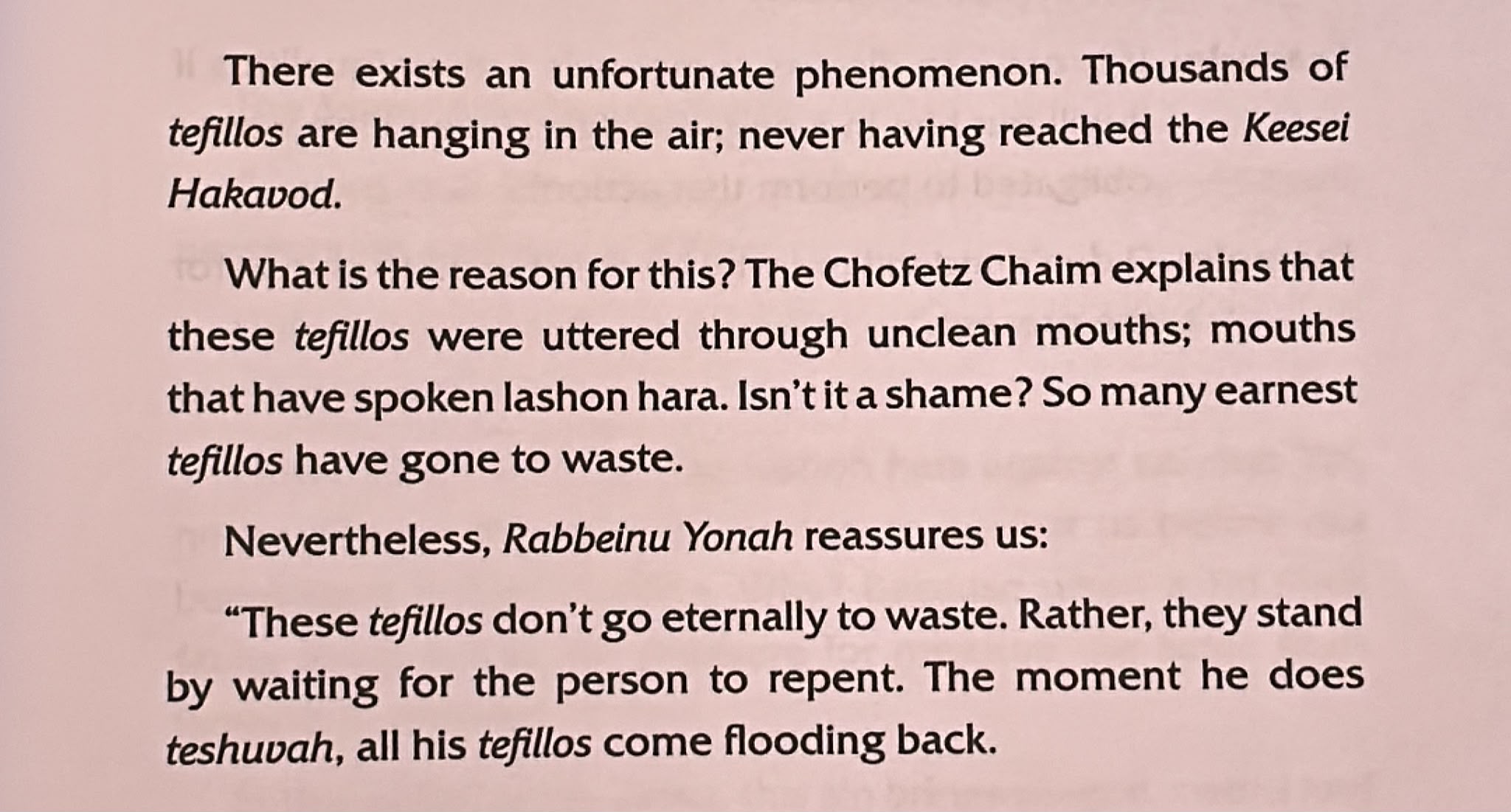
Day 21: