📖 Read this voice note
We continue this year in Sikha-e-Sfadan, Sa'if-Blaij-Nun, paragraph 250. Habinazal said very short, stated short, difficult, of course, to understand, but we could learn a very vital lesson. Inazal said in general, people who are very concerned about earning a livelihood, going out to get a job, going out to go into business problems that beset a person in a trade or a business venture. In general, whether he will have enough to feed his family, Inazal said, what is there to worry about panasah? Why should a person worry about earning a living, making a livelihood? What's the reason for this worry? What's the worst that could happen? If he has no panasah at all, literally no panasah, and as a result he has no food at all, no bread at all, the worst that could happen would be that he would die of hunger. That's the very worst that could happen. In that case, Habinazal said, so what's the problem if he dies? A person has to die anyhow. What's the difference? What does he lose? He dies. He had it anyhow. He dies of hunger. But still, what's the use of worrying about panasah? The worst that could happen is something that's going to happen anyhow. Let's say it'll happen a short while earlier, but there's no hiddish. Nothing different will transpire because of the lack of panasah. This is what Habinazal said. And of course, what is really meant by that? A person has to die, so he dies. A person's life is very valuable. You know, speaking about the life of a Jew, I'm saying so what? After all, the mission says that the life of a Jew is so precious, that you could live one minute longer. In that minute, he could do a mitzvah. One mitzvah works more than the whole elamhabah. The whole ganadin of eternity is not worth the act of one mitzvah, because that cannot be done again. What is meant here is, that Minazal said, meaning was, a worry is what is superfluous. Worrying is unnecessary and unwarranted and very wrong. Because the worrying show that this person is not living a proper life. A Jew who lives without emunah, without faith, without mitzvah, in Hashem, that's not considered living. So what if he dies? It's not living. The life of a Jew is the emunah of faith. Sanik demunas yichia, the kometz vaseche emunah, the whole life of a Jew is based upon emunah. Emunah mitzvah means that a Jew is supposed to have a very powerful mitzvah, to believe implicitly that Hashem provides nourishment, livelihood, food, every living thing that was created. Hashem created millions, trillions of different types of life. Animal life, bird life, reptiles, worms, plant life, everything requires nourishment. Every one of those, millions of species, every one of those Hashem individually, alone, takes care, be ashkoha, protein and seeds, every one of those is fed every day. So a Jew is supposed to serve emunah shlenovah, since Hashem takes care of everything, he is zoned over finest like oil, provides food for everything and everyone, surely Hashem will take care of mitzvah. To worry about panahsa shows a lack of mitzvah, a lack of faith. Therefore, men of all said, what is there to worry about? The worry itself is wrong, worrying itself as a crime. Definitely wrong for a person to worry, because in general, let's even take it from a rational viewpoint. What good does a person accomplish with worry? Will the worry get him money? Will the worry bring him food? That worry will only give him ulcers, it'll only make him sick. It'll accomplish nothing as far as providing him with his necessity. So the worry, physically, is damaged. It causes a lot of harm, physical harm, mental harm. The worry is an indication of a person's lack of emunah or lack of mitzvah. Therefore, men of all said, a Jew is supposed to live. Live how? With emunah or mitzvah. And to believe implicitly to know that Hashem will provide. Don't worry about panahsa. Yes, Hashem provides for everyone who provides for you too. Every Jew is mocked down in heaven. Hashem will see what they have panahsa. If you have mitzvah, you have created the kaili with which to receive that panahsa, that nourish, relax. Hashem will provide. That's the attitude that Hashem will definitely provide. As long as you have the mitzvah, the emunah, you'll receive the providing by Hashem. Of course, you can't sit back at home, fold your arms, put a basket in front of you, and watch the coins drop in. That wouldn't happen unless towards Sadiglouz emunah is so pure, there it could happen. But we are not in that category. We aren't people. Today in that category, when emunah is so strong it creates, it could actually create gold coins with his emunah, which is the power of the Sadiglouz emunah. Hedr says that Hashem showed his tamidunah. Hashem said, where do you get panahsa from? He said, look, here's a valley. A big valley. I think this valley looks like a big dish. A cone. He said, biko, biko, valley, valley, speaking to the valley. His malei, do you know it, becomes filled with Goldinar. And instantly the whole valley, ground, way up to the top, is filled, piled up with Goldinar. Billions of dollars worth of gold, just like that. There's no question. He said, if you have emunah, you have bitokhan. You have shefa. You just get the cup. I just use this cup with my shefa. Bitokhan, there's the shefa. It's filled with Goldinar. Each person in ratio is the degree of his emah to bitokhan and the amount of work he puts in little. Something to show that he is. Shamu bless him that he'll have panosso and panosso beshefa. Of course the ratio, the amount of panosso beshefa is totally in the bitokhan. There are other items that the Imora mentioned a few times, but also help for panosso. These are the assists for a person who's having more panosso. They could, as I've been in those since here, they're a particular person. Do not worry about panosso, because worrying is a bad sign. Person should have complete bitokhan and simkhana.
📖 Read this voice note
The question is, again, we say that there is no comparison between a person who leaves guys outside of the edgysale, comes to the edgysale to be buried. The one who lives in the edgysale, the question is, what about, yeah, Kohl Wabinu, who left the edgysale at the time of famine to go to Egypt? What about Yosef Azadik, who was in Egypt and did not return to the edgysale during his lifetime? The answer is that they did not go willingly. They went by force. Yosef Azadik was forced into slavery, sent to Egypt, there he was kept to by the order of the king. It was not a voluntary act on his part. Yeah, I call Wabinu had come to Egypt in order to receive food or actually die of starvation in the edgysale. He could have, of course, lived in the edgysale and have food brought to him. There was a question of having the family kept together. For this reason, he was forced to come to Egypt, remain there until after his passing. The United States says again about the greatness of the edgysale, that any person living in the edgysale is automatically assured of olam Habab, Afghanistan, even the lowliest person, even the case of a non-Jewish slave owned by a Jew, which means that he is very slightly partially Jewish. Non-Jewish slaves required to obey a limited number of Mitzvot, which means that he has a trace of Jewishness in him. Not really so, but he's more than the average goatee. Even he too is assured of olam Habab. The United States says that even one who does not live in the edgysale, goes to the edgysale, takes only four steps for Amut in the edgysale, he too is assured that he will eventually get to Genedan, he will get olam Habab. The United States asks, what about those who live outside of the edgysale, who do not get edgysale? And they are at the edgysale. Would we say that they do not get Genedan? Would we say that they do not rise up when Mashiach comes at the edgysale? They don't come back to life at the edgysale? The United States answers, when Mashiach comes, they will be at the edgysale, and the dead will come back to life. But only in the edgysale. In the Jerusalem edgysale, outside of Israel, the dead will not come back to life at the edgysale. These few have Tzadikim, buried outside of the edgysale. What happens to them? The United States says there are tunnels in the ground, and these Tzadikim will roll, will travel through this tunnel to the edgysale, and there they will rise up. The United States asks, isn't this a tremendous suffering for these Tzadikim? Imagine rolling along in the earth so far from outside of Israel, there can be hundreds of miles, there can be thousands of miles. Rolling along, that's torture. The answer is that these tunnels will be made high enough that Tzadikim will be able to walk from wherever they're buried to the edgysale in this underground tunnel, and once they come there, they'll rise up out of the ground alive. But they will rise up only in the edgysale and not outside of it.
📖 Read this voice note
Unless a gobble said, a person should be very careful not to allow himself to ever lose his temper. This is what he stressed above all else. Unless a gobble spoke about the evils of a person losing his temper, about tasks, and this we know there are thousands and thousands of statements from further generations of the Himalayas, I think I must speak about this. To this I'll, at the end of the day I'll especially, and I'll put it in my hands, speaks about the fact that a person who loses his temper is actually tearing apart, tearing to bits his own shama. He loses his nishama, khash shama, and without any shama he cannot perform the mitzvah. So what happens when a person does mitzvah after having lost his temper? What happens to the mitzvah itself? All this khah, the reward for that mitzvah, after shama goes to the, to the evil spirits, nukhish tamayah, so to speak, and then of course there is all this, and of course the mitzvah goes on to say that it's very difficult for a person to do chubah, because no matter how much he cries and states his regrets of having lost his temper, he wants his nishama back. It isn't possible to do chubah for this, the only chubah possible is for a person to insure against khash, which means to really do chubah by not losing his temper anymore. It's a difficult item. The Menendal said this was one of the most difficult items of war. In fact, the Menendal said that the person who wants to really control his possible unless he is offered to walk four steps in the nishah. That's why that alone is enough reason for a person to strive for the chusah of being in the nishah. Again, it is a chappayah.
📖 Read this voice note
The man that I spoke about, one of the keys to his success, that was that every day he would not continue where he was up to the day before, he would make a new fresh start. Once starting anew and serving Hashem starts with a boundless energy. If he continues where he was before, he feels sort of tired from the past effort. That's the key to a person's success in serving Hashem. He must make a hascholo hadosho, a new start every single day. Many times too, he must make a new start within a period, within the same day itself many starts. The person says, no, I will start to serve Hashem, no, I will start to learn. He sits down to learn and finds that he is suddenly distracted. He can't concentrate and so he gives it up. But he decides he'll start tomorrow. That's the mistake. You feel that you are fallen, the level you are on, the level you'd like to be, then renew your strength, renew your resolve, and start again immediately. Mr. Maynardal said it happened to him. He made many fresh starts within one day's time. This was the key to stopping oneself from slipping away. Because in serving Hashem and working hard, you do elevate yourself. But if you allow yourself to fall, to slip away without checking his fall, of course a person could lose more than his gain. The key to it, therefore, is that a person should always start anew. New and fresh with a fresh resolve. As though he never started to serve Hashem at all. He considers that important line, of course, that he can really serve Hashem properly. As long as a person does not have this power of starting new, may not say it's impossible for a person to really begin to serve Hashem. This is the key, must be. Maynardal's famous saying, a person should never be zaki, never be old. Be a youth for your life. Have young, fresh, vigor, energy. That way you can always serve Hashem properly.
📖 Read this voice note
You want to say now that the speaking about all these dates times Mashiach's coming let us Establish the final rule. Let's erase all the statements about dates established time Mashiach's coming Let's make it clear that it depends purely upon one single item Shea, of course, there is a certain time will come but his coming depends upon Chuvah if the Jews will do Chuvah That's when Mashiach will come now. This would mean to imply You need to apply the house visual if the Jews will not do Chuvah. They cannot expect to see Mashiach coming Shea will come if they do Chuvah. What if you have a world filled with people who just don't do Chuvah? They hold back. She has coming forever. He wants to be sure it says house visual Shea must come at a certain time We have learned previously that this world was created with a deadline not to last forever Mashiach created the world and created to last for a given explicit time the maximum time is 6,000 years so Mashiach must come prior to that time. We say that he'll come only if Jews do Chuvah Yes, but if they do Chuvah, he will come if they do not do Chuvah Hashem will force them to do Chuvah How Hashem will let rise up a wicked king a wicked ruler who will torment Persecute the Jews until they be forced to turn and come crying that shem for assistance crying that shem those who had no faith They will turn that shem now with complete faith and plead that shem help us This is faith and this is Chuvah. This is what will bring Mashiach We have seen this now a time when the Jews were attacked during the days of the Holocaust at that time We saw the least religious Jews turned to complete faith and a shem apparently the time was not yet, right It was not real Chuvah you saw it again when the Jews were Defending their lives in Israel against such insurmountable odds tens of millions of Arabs enemies against them and The miracle that we witnessed the last six-day war miracle which brought a lot of non-believers back into emunah faith in a shem the tiny iota that is necessary yet is Obviously taking place right now little left for Chuvah because we see now that it's not one country It's not one ruler. It's not one group. It's a united effort the part of the entire world There is no exception united nations that are completely united you have such diversified groups Different sections of the world that are so different in opinions and ideas They could never be expected to get together on anything yet in this one single item one single item They have all joined forces joined beliefs as radical as it is That is that every one of these unit nations is united with the intent of attacking and Eradicating the Jewish people has a show there is no exception even those who are allegedly our friends who pretend to be our friends In the long and short run they reveal their true colors So this is what's meant a shem will let rise up a leader a world an entire world to turn against the Jews There's no place to turn for a Jew after that. Do we turn for assistance? We go to the leaders of our allies who are definitely against us the leaders of the Establishment the leaders of the comfort of the epicursum We will place the turn is not to the four corners of the earth It's only direction upwards up to a shem. That's the only escape only means of salvation for us All Jews will realize that then we'll be deserving will merit the coming of a shiach readily This is what a shem is waiting for and this is what is expected of us
📖 Read this voice note
Ferdinand says, this lesson teaches us that there are people who legend Jews who will hold out years of persecution, years of suffering, years of being dominated by the Gullion, years of shedding blood, seeing past generations of sacrifices made by Jews, and they see that all to no avail. Getting darker and worse, we keep going downhill, instead of having one enemy we have two and ten, and now it's over a hundred of the United Nations, and it keeps getting darker and darker. There are many Jews now, when they see this, they give up. They give up hope and they fall away. These fools realize that all this is predicted by the Novi. The Novi Shri Novi says, we oil the ace era vie or know that when it comes evening, when it turns dark, at the darkest moment, at the seemingly pitch black second, that's when the bright light, bright glare of sunlight will come, which will reveal the coming of the Shri Yen to all his suffering and darkness. We have to know that at this moment of the morrow, the bitterest and darkest moment, that's when we are tested with our faith. And those people who will hold out at a time like this, that faith remains steadfast, forward, this is what the venerable said. You know that a shining mirror, the world will be shaken at a time when she comes, as you shake out a blanket or a sheet to get rid of any dust on it. The whole world will tremble like an earthquake. Then trembling all those who are weak will lose their grasp and will fall away from the world, will be destroyed. It's only those who have a tight hold on each other, give us those who strengthen themselves with true aluna, that they will remain attached. And there will be zekh to see what happens after this earthquake, after this tremor. But the coming of Mashiach, the true sympathy of seeing the ashore of Cholias, all this suffering will come to an end. The Jews will finally be able to return to the victory, to the glory, to the energy soil, the land of Israel, the land of Hashem, guided and governed by the Tadak dayshark, with only Hashem as the king of the entire universe. The day when Hashem will be echad u shmai echad, to stay with the coming of Mashiach, the many a besameek, the shmai, the many a humane, the humane.
📖 Read this voice note
Benelos says that a person having this blessing of a mind or brain should utilize it for a good cause. That good cause is for a person to sit down, literally sit down, and to think, and to consider, and to take an account of his actions, his actions on earth. Of course, to spend a certain amount of time each day in simple meditation, to review all he did during that day, and to regret that which was wrong, to repent for any wrong done, and thought or an action, and to resolve mentally that hence he will not repeat these wrongs. However, Benelos says that it sounds simple. Meditate, sit down and think. Review in your mind, take time out, how much time out, half hour, 15 minutes, 10 minutes. Seriously take time out for a period of time during a day. It's best, of course, one hour, if Benelos says. One hour to think about his actions, his deeds, and to review them truthfully. However, the fact is that very few, extremely few, are ever such to really take time out each day, and to review, to think about their life, and how they spent it, how they spent the time of their life. As the time passes, each day, each week, to think, to review, to reconsider how to improve his own deeds. Now, there are some who plan, plan to sit down and think about, but as days go by, weeks go by, the people who are even serious minded find that they have never really sat down to consider to think about. And that's how it's possible that a person can let his whole life slip by, always postponing, procrastinating, delaying this meditation until he finds that his life has ended without one single day, one moment of real meditation. That's why this requires a very strong resolve. A person should battle against his own nature to strengthen himself and seek to make, to create time, create time to sit down and to really think about his lot, to review as he should, and to understand, to arrive at what. What is he supposed to think about? What is the goal he's supposed to finally achieve in thinking? The fact is he's supposed to realize the truth about life itself. The fact that life itself is so meaningless physically, physical part of life, meaning those things that are physical desires, those things people strive for a whole lifetime. They work so hard in trying to achieve a certain level financially or financial security. And all these things are so meaningless because the end is that a person just leaves all this behind and it's worth nothing. He cannot take anything of these items with him. So if he achieved great wealth and he has to leave this world the end of his lifetime, this whole wealth is like a wisp of smoke. It's nothing at all. This is what a person must understand, that the material gains in this world are meaningless and worthless. The spiritual gains, the vits he accumulates, those are the ones that count, those are the ones that last forever.
📖 Read this voice note
Rus, the son of Bolok, became the wife of Bayaz, a great-great-grandmother of David HaMalach and Moshiach. That means that directly the son from Bolok, this washah, was Moshiach. Imagine a person should be served such a great coveted honor for what? Because he bought sacrifices to Hashem, not for the sake of Hashem but for the Sholishmo. Still, if the Sholishmo has such reward, imagine the reward a person has for serving Hashem with sincerity, with honesty. The sort of Hashem, reading the Shmo, the course of the sake of the arm of Hashem, imagine what reward can come from this forever and ever after. If a young Shmo Moshiach can read about a reward to becoming a Moshiach, then surely a Moshiach. Therefore, a person should dedicate himself. And though he feels he's not doing well, but at least do, you have a chance to admit to do it. Even though it's a mitzvah that's crippled, you see the arms and legs are crippled and the action is poor, do it still because good will come of this. Some good will come out of it. And eventually, eventually come better, they'll be able to do it to a much better extent than to a case of the Shmo. Because they must come good to any mitzvah. That's what the Lord tells us. And this is what blesses our stresses. A person should always serve Hashem. As weak as he thinks he is, it is still very precious in the eyes of Hashem. It's like a small child is trying to walk in his cute in the eyes of the parents. The child grows, of course, becomes able to walk by itself. This will be the path the Jews should take, always striving to lead to Hashem or the path that goes to Kedushah. This path, of course, is solid only when it is attached to the psaligemus. Because when he holds on to this person, he is sure to get to the proper goal. Let's hope that we'll be there for this true discussion of the psaligemus. And that's because we're able to see the coming of Moshe of the
📖 Read this voice note
The Eucharist says about Yeshua Levy, that one time he came to a cave of Abishul Bayechoyzal. This is a cave burial place in the city of Myron. Those who were privileged to be in Israel were there, or those who were expecting to go should know that this spot is definitely the holiest, the one of the holiest spots in Eretz Israel. If you go to Israel, that's the one specific place in the Goliil, you should make every effort to go to visit at the Daven at that place. Yeshua Levy came to this cave of Abishul Bayechoyzal in Myron, the door to the opening of this cave, stone cave, and there he met Eliyahu Hanavi, who was standing at the opening of this cave, at the cave of Abishul Bayechoyzal. During the Abishul Bayechoyzal lifetime, the Israeli college we find, Eliyahu Hanavi used to come to Abishul Bayechoyzal constantly. He used to study Torah together, and Eliyahu Hanavi used to call Abishul Bayechoyzal Rebbe. He used to regard Abishul Bayechoyzal as a Rebbe, which is just about the only case we find in the Gomorrah. Because in old cases, whenever Eliyahu came to Rebbe in the Gomorrah, he came as a teacher of that Rebbe. Abishul Bayechoyzal's case, he came comparatively as a student. So here at the entrance to the cave of Abishul Bayechoyzal, Yeshua Levy met Eliyahu Hanavi. He greeted him, and he said to Eliyahu Hanavi, I would like to ask you a question. You, being an inhabitant of heaven, could you tell me if I will receive Canadian? Of course, it's a very sad state of affairs. If Yeshua Levy asked that question, what should we say if he had to ask that question? But he asked this question of Eliyahu Hanavi, and Eliyahu Hanavi answered to Abishul Bayechoyzal, you will receive a long haba if this master here consents to it. This master here, Abishul Bayechoyzal said, I saw only two of us, but I heard a third voice. This master referred to the Shechina, the spirit of Hashem who was present. Hearing a third voice, of course, meant I heard the affirmative answer to my question. I was going to get a lot. Then he said to Eliyahu Hanavi, I have another question to ask you. My question is, you tell me, when is Mashiach coming? Reveal that time to me. Eliyahu Hanavi answered to Abishul Bayechoyzal, I suggest that you go ask Mashiach yourself. Why not ask him? Fine. And so he said, I will tell me where he is. We'll come back to this in just one moment, but we cannot help but stop here for a second. Who was, with amazement, at the controversial item? A lot of controversy over this item. And here we see definite proof. Those who argue against this are literally blind. Question about the mitzvah of going to visit Tiel, the grave of its addict. There are some people who are opposed to it. Go to Israel to visit graves. Is that what a tourist does in Israel, visit graves? Or to go to a grave of its addict, to daven there? Shouldn't you go to Shul better? The importance of a grave of its addict is so much that here we see that Eliyahu Hanavi, who lived in heaven and could have very easily and did very easily, continually, speak to and study Tiel with Abishul Bayechoyzal in Genedin, still came to visit the grave of Abishul Bayechoyzal. He's not just in the showroom in heaven, but also the grave itself, the place of burial is that sacred and that holy. That the Eliyahu Hanavi came down to visit the grave of Abishul Bayechoyzal and the shechina. Even the spirit of Hashem showed Kaviyachov the respect for Abishul Bayechoyzal's seal. Imagine this. We can see very clearly how big, how great this chus is of people of our stature. Any Jew who cannot visit Genedin to speak to Abishul Bayechoyzal, but who have the ability to go to the seal, the cave, and the grave of Abishul Bayechoyzal, imagine how much we should strive for that privilege and how much can be accomplished there. As is written, that the grave of the tzadikim, these graves, a person can daven there and know that the shechina is close by and that his tfila will have so much more effect. Because at that spot, the spirit of the tzadik buried there will assist him. Helping his tfila should rise up to heaven and it should receive the reply. We see that Abishul Bayechoyzal also visited the seal of Abishul Bayechoyzal. What else was he doing there? So no person is too big or too great to be able to visit a seal. That's why it is customary among those who are really Baalei Amunah, Jews with faith, religion, that they often, as often as possible, go to the graves of these great tzadikim. Rechoyzal or even the Oversagdishim. The chevron came of four couples, daven in the place of the burial of Adon Marishon and his wife Avron Mitzengiak over there. Why is that? Rechoyzal came of Adon Mitzengiak, a quorum of all the great tzadikim, past and present. The tzadikim of our time, too, are buried. They, too, can assist us immensely. As the Israeli Kurdish says that we today would have no chance whatsoever of existing. If it wasn't for the tfila's, the prayers of the tzadikim will pass away. So we know that it is within their realm of their power to help us. That's the reason why we should visit their tzion, the request of them to assist us. To what? We need material assistance. Also, especially, we should be zelchat to purify ourselves, to do chuvah and to freely serve Hashem in the way Hashem wants. The way Hashem wants in the way that's taken ourselves to one.
📖 Read this voice note
Hashem sent to Mosh Abenu. Tell Pinchas, I extend my greetings to him. He goes by law that the Calhain gets murdered, even if it is not intentional. He is unfit to carry out further this service in the base of Meknash. Tell Pinchas that not only is he fit, but he will never become the Calhain Goddaw. He is the symbol of purity and shameless completion. Of course, I have this act of kanos. Now, this kanos is a very delicate item, because a person today would imagine, let me become a kanoi. Let me go out in the streets, find me a Jew who commits sins and split his skull, and then I become complete. He'll be a real good person by knocking off all the Jews who are doing wrong. In that case, Abenu is also a person who says that, fine, he should start with himself first. Hook in the mirror, be honest with yourself, and start with yourself. You'll have a one, first good deed done. A person cannot be a kanoi today, actually, because for two reasons, a person would start to criticize others, always, that could be said to him, first, improve and perfect yourself before you can afford to speak about others. The second place, what is most important is that he says, we fight. Even in the case of the most famous kanoi of all times, in the case of Pinchos, who continued on as Eliyar Navey. When Hashem asked Eliyar Navey, what's bothering you? Why are you so upset? He answered, kanai kanisi, because I want to avenge the honor of Hashem against these wicked Jews. They are worshiping idols. They are traitors. They are rebelled against Hashem, against their Creator. Hashem said, you, on the leader of the Jews, you tell me that the Jews are worshiping idols? Don't I see this myself? If I see it, what do I need you for? I need a leader like Moshe Rabbeidu. That's what I call a leader. When I said to Moshe Rabbeidu, I said to him, like great, good dummy, because the Jews are committing idol worship, I want to wipe them out. Moshe Rabbeidu said, no, you don't. Hold back. If you wipe them out, I go first. This is your blackmail. You go first. He said, yes, I will not let you. Hashem said to Moshe Rabbeidu, Hanikhali, please let me, please allow me, please release me. Hashem said, Kamiachon, please release me, allow me. And Moshe Rabbeidu said, never, I refuse. Hashem said, that's the kind of leader I want of my people. The Jews are white people. They are white children, whether they are good or bad. They are still born of what Hashem. I know what a leader, an avenger, will turn against my children. But if you do, you may be even in the yard of me, but your time is up. When he made that statement, Hashem said to him, you're through. Throw and appoint Alisha Naveedu in your place, unless I cannot take you as a leader any longer. To say we find the case of the later prophets, those who spoke against the Jews were ejected by Hashem. Hashem wants that a Jew should speak only good about others, regardless. He should judge all other Jews to the good. But if he does so, he is assured of being judged, the kapschus, the good from heaven by Hashem himself. This is a cardinal special rule above all else. If Jews follow that pattern, that rule, then they will have Hashem as their savior will sin with Sheykh Hashem, and they will be deserving of the Yulah Shlimo. Therefore, this is something that each person should take seriously to mind. Search within himself, where have I done wrong, and ever speaking unwittingly about another Jew's faults. No, yet this has brought about a kid through a kapschus show may hushed in from above, either against the one who spoke, or against the one that was spoken about. A person should seek to it to invoke the kapschus of Hashem for individual Jews collectively for the entire Jewish people. We should be honored to speak to one of the Highland Foundation, pure in holy words at all times, and bring about the ticker of her Bris, Bris Halashun, which is united with the Bris Halua, which brings about the Bris between Hashem and the Jews, with which we will see Kami Mashiach and Keilu, be the best victors of Heila, Kameil, and the Kameil.
📖 Read this voice note
Beninel says the one of the most important items in life is blessing, being able to receive advice. A person has a wise advisor, then it removes the doubts that are in his mind. He doesn't know which turn to take, which step to make. He has an 8th advice from a Chacham, Talmud Chacham, that clears the way for him. So it's very important to have a good advisor, same time it is equally important for a person to accept this advice. What is the use of having a Talmud Chacham or a Tzadek advise you if you refuse to accept the advice when you decide to follow your own decisions rather than the advice of a Talmud Chacham? How important this is, the Beninel stresses that a person who does not follow the advice of the wise can actually lead to a degree of insanity. A person can become insane, in a way, so it's a logical reason for it, because in general, what is insanity? How do we detect the person who is insane? Of course, this person does things that are wrong. For example, he feels that it's proper to go with torn clothes and to roll in the dirt and ashes. This is what an insane person does. Or to dress in a strange manner, to act in a strange manner. If this person, as insane as he was, was forced to act properly, if there was some advisor who could physically force him or could persuade this insane person or semi-insane person to follow his bidding, this person would no longer be regarded as insane because he is acting in a normal manner. So what makes the person insane? The fact that he does not follow the bidding or the advice, the instructions of a wise guide, a leader. This is in a physical sense. St. Tolkien's spiritual sense, a person who has a Talmud Hachem or a Tzedek, who guides him along certain lines, tells them which mitzvahs to perform, how to perform them, which things to stay away from, how to avoid pitfalls, evil inclination, evil desires. And this person refuses to accept this advice, and he definitely could be classified as insane. A much worse insanity than a person who is physically insane. He is a spiritual moron because he has the chance, the opportunity to follow good advice that can lead him on the righteous path, can lead his soul to a direction where he could earn for himself eternal life. On Canadian Paradise, he rejects that this person has reached insanity. Therefore, it is understood that if a person feels within himself that he is doing things that are wrong, the solution is naturally to go to the wise, to the elders, to the learned, and receive their advice and follow it. Once he does that, no matter what happens afterwards, he knows that even if he feels perhaps he's doing wrong, surely he's doing what is right. He'll be classified in heaven as a person who is wise, because he, in fact, he is doing what the wise people are doing, what they will tell him to do, what they themselves will do. This means then that a person, though he is not educated, oh, he's not advanced in knowledge, oh, he's not advanced in good deeds, yet by emulating those who are wise, those who are watsadikin, by following them, he can be classified himself as a khakhrm, as a wise person, and as a tsadik. He that Nusseldall says is the words that are very rarely added, Nusseldall says, we have been hated, understand this very well, very deeply, understand which means you, every individual who thinks that he himself is not learned, he's illiterate, he's not educated, who am I to be able to follow advice of so great a tsadik? Nusseldall says understand what every person is included in this, that he's the lowest person, the most simple layman, if he follows with sincerity, with simplicity, the advice of these tsadikin is much better off, he is much more normal, much more sane, and he's great, so-called wise philosophers who reject the advice of these tsadikin, go on their own wrong path, they are the ones who are spiritually insane, those will have to eventually pay for their deeds, so understand well that there's a very simple solution for everything, we don't have to delve too deeply, not too difficult an item, simply with simple faith, accept the words of the tsadikin, just as with simple faith, we accept what the Torah says, whatever is written in Torah, though it might be a controversial item, though you may find that there are very learned people, professors, and colleges who criticize the Torah, so-called Bible critics, and yet we accept the words of the Torah with faith, these are the words of Hashem, we will not question it, we will follow it implicitly, this is the correct steps out to what the advice of tsadikin, person during that ashe laydikas, then his whole life is one pure sequence of act, where he knows that eventually he'll reach the peak, and pure the kudusha.
📖 Read this voice note
then no one can say that if a person assists upon saving his money by carrying it less than four almost at a time, or by giving it to a guy or those other solutions that he should not bring, you cannot say that he is bad, you can't say he is Mahalo Shabbos. But one who is stricter, honestly stricter, would point that he would either stand there or Shabbos, or else he might go one step further. It's that step further that I once witnessed myself. I was about 10 years old, I was walking with my father, Shal Deshoel, and suddenly he stopped with a shocked expression. He found that he had in his pocket his gold watch. Those were the days of real poverty. Real poverty meant that there was very little bread in the house. Cake was unknown, a little bit bread. Gold watch was a memento, something that was sentimental value besides, of course, the real value of gold, brought from the old homeland, Russia, and it was the one island that remained as a memento, which no matter how much money could help, buying food, a person would not sell this one item. And he held out with this gold watch, never pointing it or selling it, no matter how much in die and need we were. Of course, Hashem always helped that if there was a shortage of bread, there was enough bread to sustain us. This time, this was on Friday night, and the shocked expression, and I noticed the alacrity, the speed, the, without the slightest trace of hesitation or thought. He just took the gold watch out, dropped it to the gutter, and walked away. I was shocked at the time, and it remained sort of embedded in my memory, because it wasn't the gold watch, it wasn't the item itself, it was the expression. Expression, that, for that second, one second, without thinking the immediate action of a person who's filled the display of true, pure Yiddish Shemayim, respect for Hashem, respect for the tenor, respect for Mitzvahs. No thought about sacrifice whatsoever. No thought about how to salvage it. Perhaps there's a way, of course, he was very, very well aware of this Kimura, the Shulkhonorah, who's a Yitzadi-Kolomden, the emus, and despite that, more than his wisdom and knowledge was his Yiddish Shemayim. That's what he says in Pirke Alvay's, that's ashrait to the person whose Yiddah stands above his Hachmo. The sphere of Hashem, respect of Hashem, is higher than his wisdom. So that's, it's for us to, perhaps we cannot emulate it, we cannot copy these actions, but it's good to know about such Sadikam who existed in our time.
📖 Read this voice note
Abenazal said to Abnosazal. Abnosazal told that one day, Abenazal said to Abnosazal in a questioning tone. Have you ever heard for me any Divide Musa? Musa means any kind of lessons that are inspiring lessons that will teach a person Yiddish mayan fear of Hashem. Mitzvah is, and he said, because I can't, I feel I cannot speak words of Musa. Every word that I say is soaked, saturated in tears with who part of my heart goes into it. Abnosazal was surprised at first. Every word that Abenazal spoke was Musa. It was something words that were fiery that could arouse a person. But then he realized that there was a difference. The regular means, the regular method, the regular type of Musa spoken by Magidam, by those who speak, lecturers who speak words of Musa, that Musa always is, you are sinners. You are wrong. You are committing crimes. Wake up before it's too late. You're going to suffer. You're going to pay for your sins. That's the regular type of Musa. Mitzvah, you do all that good enough. You've got to try harder. Abenazal's words, the contrary, never stressed that. Abenazal's words were ones that inflamed. Within a person, the desire that was so strong, the craving desire to serve Hashem, the desire was so strong that a person literally lost any evil thought. Every person is endowed with Bikhira, free choice. You can pick either the good, the way of life, the way of Taita, or Hashem, a person you can turn to sin. But a person lost his Bikhira when he heard Abenazal speak. Abenazal spoke that the whole sign of evil completely left him. There was only one thought, one pattern, one path in a person's mind, and that was the wonderful idea that he could now serve Hashem, nothing else. Because of the power of Abenazal's words, Abenazal says that anybody, anybody, whoever attended Abenazal's Shia, ever heard a sentence from Abenazal testified to this fact that a sentence, a word, a lesson, the fact that Shia by Abenazal was enough to give a person a renewed life, renewed vigor, renewed spirit, it elevated in the Shama, it went soaring up into heights far beyond that you never experienced before, and completely in a sense of one sentence, a oneness, just purity. Only if the Taita was left. So this was in the days of Abenazal. What about after Abenazal's stonkus? What about for us? We never had the Zikhira to see Abenazal. Imagine that Zikhira. We never had the Zikhira to see Abenazal even, to hear Abenazal. There were no recordings then, no tapes left from Abenazal, or from Abenazal either, or even from later generations. Riklachalazal, very, very sad that there were no tapes too. The tape recorder was invented just after, just too late. Came a bit too late to get to Riklachalazal's voice on the tape recorder. He had some of his shooting of prices they would be. But surely they're none of Abenazal, Abenazal, and even, even the Shia of Abenazal, in a sense is closed. Donicate Sien and Abenazal's path. The road leading to Abenazal Sien is in mourning. It's a mourning because the sadness and the fact that this road is so unpopulated. The road itself desires to have people going over it. To get to Abenazal Sien with Abenazal's own self stated very clearly, vowed, gave his promise, any person who would come to his Sien, Abenazal said, I will perfect just as much as during my lifetime and even more. There's a guarantee, an eternal guarantee, to a person who gets to Abenazal Sien. That path today is in mourning because very few, if any, get there, you know. It's closed. Close up, they show him, read, they show him who blocked passage, entry to the Sien. So we don't have the opportunity to see the Abenazal, to hear the Abenazal, even to come to the Abenazal Sien. What about those powerful words of the Abenazal which could inspire a person, which could infuse into a person a new life, a new Nishama? What chance do we have today? Nishazal says, we do have it today. Today, not just in Nishazal's time, but even now we have it. Anybody who, honestly, sincerely take any one of the Abenazal's form, open it up, read it, you'll find a light becomes illuminated in your mind and your heart. And you have a new desire, a new life, a new life in which you want to live a different, purer than before and previously. A person continues with this. This was two words about the Abenazal. From the Abenazal, a sforum that Abenazal wrote that remained from him. These today act and serve as living words coming from the Abenazal. A person today could very simply hear or see the words of the Abenazal by learning his sforum. Fortunately, we have it at Nusanzal, the Abenazal's main chief disciple who recorded a vast amount of the Abenazal's sayings. The fact that, which we're learning today, we have only the Nusanzal to thank for. We have these words today from the Abenazal and with this, at least if we have that opportunity, let's take advantage of it and to learn this on a steady basis. A person should resolve. Never to let one single day of his life go by without learning at least a few sentences, a few passages of the Abenazal sayings. Very simple. The words are written in very simple and clear, lucid Hebrew where even an Abenazal student can understand them. As you see from these sforum Abenazal statements, they have very elementary. Every person can understand it. There's nothing that deep, that difficult to grasp. Yet, as simple as it is, it is made for the biggest sonic and for the greatest Londoner. He too could benefit and gain from this. If he takes this with a humbleness and sincerity, he'll find how much more he has to gain by hearing, reading, learning the words in a better way.
📖 Read this voice note
Maynizal spoke further about the Indian mission to Kunizaya. Maynizal said, very modestly, of course, we know that the Maynizal's anivis, his humbleness and modesty was second to no. He reached the highest degree of anivis possible, close to Meshavnabene. So when he spoke about his own praises, they were said in a truly modest form. It's difficult for any person to achieve to be able to speak about himself, yet to remain modest. Meshavnabene wrote about himself via the humblest of all people on earth. On a Mikol Hotham, not to feel any sense of hoardiness. Maynizal said that he was a child. As a child, he had learned through besides the regular studies of Thai, Gemara, Shastra, Peskin, also all the Sifre Hazera Kodish, the Sefer Tikunim, Tikunizaiha, all the writings of the Arizal, basic bulk of Kabbalah today. Itzchayim, Priyetschayim, all the Kisirizalishmen. In short, all this the Maynizal learned in his youth. The Maynizal stressed the main one was the Tikunizaiha. He spoke many times about the opinion of Tikunizaiha, and said that his regular study took him through Tikunizaiha throughout the year, even aside for the month of Elo. Maynizal said Tikunizaiha is so deep, so vast, that there are no khachma in the world, that it's not included in the Tikunizaiha. A person who has the mind for it, a person whose mind is deep enough, and has the grasp profanity of the Tikunizaiha can find in it every type of wisdom possible. All types of mathematics, no matter what field, what area it covers, is found in the Tikunizaiha. All types of music, one of the deepest wisdoms that is the wisdom of music. You know, the highest of the Tadak Desha, just divided into four parts, the letters, the vowels, the crowns, musical notes, the highest musical notes. All types of musical notes can be understood and learned through the Tikunizaiha. Of course, this takes a person whose mind is that broad, mind is that deep, but the Tikunizaiha is a safer list that it's hidden. Secrets are hidden, yet even the smallest person learning it can see in it, depth far beyond anything he has ever studied before. That's when the Tikunizaiha quotes a statement from the Igemara, you find a new light in the words of the Igemara itself. Great is God, the Igemara who learns Igemara alone, when he reads the same passage in the Tikunizaiha, the Tikunizaiha finds that he understood nothing comparatively prior to this explanation Tikunizaiha. Every word in Tikunizaiha is a whole world in itself. Every line is equivalent to many pages of Igemara, let alone imagine that in what is compared to any other type of regular, secular wisdom of today. Every kind of khakma that exists, bar none, without exception, is found in the Tikunizaiha. A person who studies it deeply enough will find it, will discover this. Nephela Ben Adol said, he praised the Tikunizaiha above all sport. Depth of wisdom, this is the chief, the main, safe hand. That is why in the month of Elo, at least a person should read through this. To know that he has said, he has davened through the Tikunizaiha. He has said words that are so holy, so sacred, it was as the message came to Mshume Yechoizal, when this was being composed in heaven. In the end of he said to him, in the end of he was the one who was going to come and proclaim the arrival of Moshiach, said to Mshume Yechoizal that with this safe hand, your safe hand is the one that is ifkumbe me galusah. The Jews will leave Golis, they'll go out and to enjoy the Gula Shlema, through the power and kudushah of this safe hand. This safe hand will light the way for them. The path is dark, they require a guide, they require a light, a lantern, the word zeha translator literally means light. This will be their light in the darkest moments, and this will lead them to the Gula Shlema. This is the Kayach of the Tzadik Emus, Shume Yechoizal, Bena Zal of Z2, that my light will illuminate shine till Moshiach comes, and then continue on. I straight to those who have this Emuna Shlema. We should be certain to this Emuna in depth, here Emuna, in the Bena Zal, Tzadik Emus, Tadak Desha, through this Emuna Nashem, and his Tzadikem, definitely be certain to see with our eyes the coming of Moshiach of the Kano, building the base of Mekdesh and Heida, Ameen Bi Ameen.
📖 Read this voice note
Vedasos says, Atresha Shonur is the main holiday of the year, the eyes of the Tsarikimis, the eyes of the Vedasal, meaning that those who are attached to the Vedasal can gain more atresha shonur than any other time of the year. Those who come to the Vedasal's minion, Vedasal's kibbutz, the assembly, can gain much more than any other time. Because of the fact that atresha shonur is the most important term of the year, that a person should be very wise, at least to the best of his ability, to use his mind during atresha shonur for a good cause. Good cause is to concentrate, concentrate his mind on the fact, the makhshava, the thought should be like its filah, like a prayer itself. The thought should be its filah to concentrate, to bring about a Yeshua, a victory for the Jews from heaven, on this day of judgment. It's a time when everything occurs, decisions are made in heaven for every individual, for every nation collectively, so that a person through deep concentration can affect a cure and ensure victory from heaven on that day. Person who thinks deeply is the same as though he doubles deeply. He attaches his mind to heaven and this sense can actually become part of the heavenly tribune. He becomes like a judge on that court and can make decisions. Just as a person who dovens, whose filah alone can affect a heavenly decision, especially if he becomes attached closely to the Tzadikimus on that day and as the fact is, the Tzadikimus not only dovens but also can decree. He can make a statement, he can dictate, and Kamiyachal Hashem fulfills. The person attached to the Tzadikimus, besides Dabing, also uses Mokhshavah. What's important about the Mokhshavah is that it affects, and in the level of Kedushah, Mokhshavah's thought is even higher than Tzilah, because Tzilah is B'peh, Malthus. Mokhshavah is the Chachmah, which at the same time, the man who says must be, the catch is it must be Besimchah. The word Mokhshavah is the letters Besimchah, exactly the same letters, therefore, using Mokhshavah, it means the person should be Besimchah then, to feel that though this is the day of judgment, though his life hangs in the balance, on this day there is written down and inscribed in the Book of Life and Health, there is inscribed this person's name, the decision is made to which book he'll be in, despite the danger of the jeopardy he is in, still he is Besimchah, and with this Besimchah, he can have the heavenly decree changed. In addition, the man who says the person should see to it that he sheds tears, unless he shows it. You know, just dovern, but you put your heart into it, because Mokhshavah too is believed in the heart. Concentrate with the heart, and a person should cry the deep recesses of his heart. The fact we mentioned once that he's all states clearly, that unless you show to the day of judgment, a person should cry during doverning. If he does, it shows that he has a soft good heart. If you do cry, it's a bad sign, hasashol, it shows that he has a heart of stone. A heart of stone, hot that is harsh, and inflexible, is the exact opposite of Breslov, because the opposite of the lave Evernor, stone is lave bussor out of flesh, lave bussor is the letters Breslov. This is what that Isal says, Isal of course, naturally, was a Breslov. Isal said that a person that you show to, again the most important date, should cry, this shows a softness of heart, this shows that his T-lot is being accepted.
📖 Read this voice note
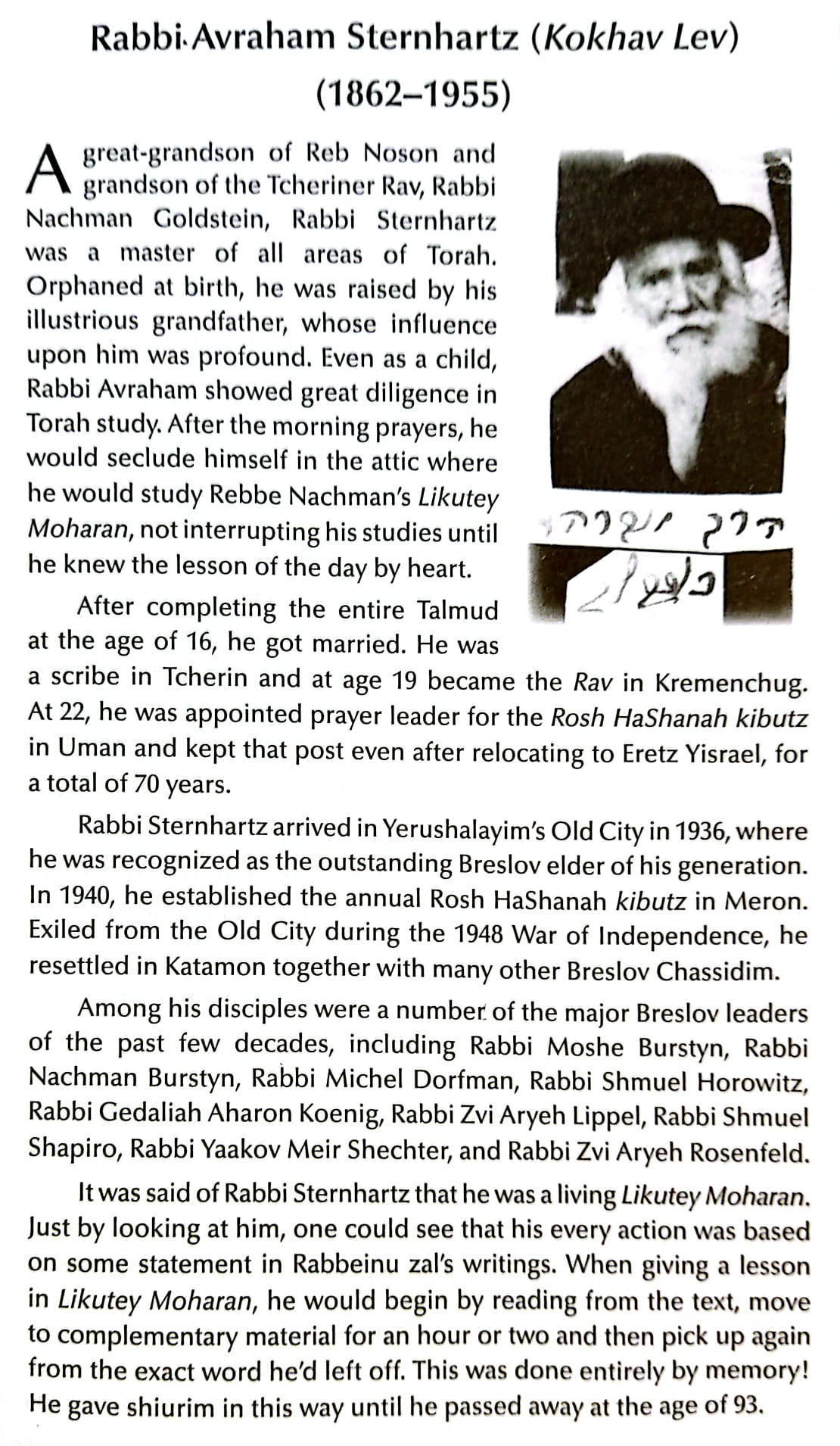
It isn't the reason why there are so few willing to recognize the existence of the Psyduckimus and why those few should feel so happy and proud and fortunate in that they are closely attached to this Psyduckimus, how much they can be right of them, as we have seen ourselves, from Ramekoff of Les Alves so. The few years that I knew him, and much more so than I've heard from those who knew him for a long time, Ramekoff of Les Alves devoted himself to being a cadet of the Psyduckimus, to bring close those that were distant. He never considered a person too low or too uninformed or too unintellectual to bring him close to himself. In fact, I saw myself when I first came to him, the world reception that I received was certainly not deserved, and yet this was done just as he did to anyone else who came to him, accepted him warmly as practically as an equal. And we kind of bring close these distantly work of the Psyduckimus, because the Psyduckimus is as high as he is, as ethereal as he is, as high a point in heaven as he reaches, that's how he descends, lets himself down to the ordinary people. Ramekoff of Les Alves devoted his lifetime, and this is probably a record, the point where he never missed the people who go to work and have sickly a time of sickness, for illness, vacation, any other reasons. Ramekoff of Les Alves his entire lifetime never took a vacation from Tickelchasseis, the legendary Fila, crying over the Chobbenbees Mikthalsh, that we never are late in his life, where he was too ill or too tired to be present at the midnight, the stroke of midnight, which is the time of the six hours after the dark. At that moment, every single night in his life, he fulfilled that Tickelchasseis. Every morning he was up for Psyduckimus, simple Fila to show that our show we dobbled it, four to seven, that's a late hour, and so after dobbling his finish, after learning his finish, Psyduckimus ended to sell this in the summer times and times as early as four o'clock earlier. At the time of the time of Ramekoff, there the rains were heavy, in the old city he fills with the rocks, and he docked us at that time, he walked through the streets and his docked us, many times he was told that he fell into a ditch and tried to extricate himself and couldn't call for help. The main point was, and the main illustration that's most outstanding is the night before his stonkness. We're speaking about an age well over 90, well past 90, that night he was already ill to a point where he was considered a gaseous, wasn't breathing his last. At the stroke of midnight, he tried to get out of bed and tried to lift himself, then he fell off the bed and lay on the floor completely helpless, he couldn't move. He lay there waiting for a strain to get up, his son was no strength at all. Hours later, people in his house he was, the Mission Bush list, came in and saw him lying on the floor. He cried out and he looked at him back on the bed. He asked what happened? A couple of days later I replied, nothing happened, I fell out of bed, and I thought that I was probably dying, so later I wasted the death, I figured meanwhile, I'll talk about gaseous, I'll have his blood it is, he did the whole thing right through regular gaseous, regular the blood it is, regular tithes, he learned everything is Baupet. Like all the others, he was possibly the only one, possibly one person in the world who had learned the entire Kutemana Baupet from beginning to end. Every single word in the entire state of Baupet. And I know the fact that he learned for many years the Kutemana Baupet was a showing, for an album of well over a thousand people, a thousand of the greatest outstanding Sadikin in Europe at that time, the fact that there was one time that he said a shia in the Kutemana, and then he said the Kutihalapha Salans, a Muslim Salaf. When he said this shia, his shia journey was between two to four hours, students had more patience, and at the end of this shia, when he finished the Kutihalapha's, a Muslim wrestler, a very famous Talmud, a Muslim Salaf, jumped up and he said war, an exacting answer, a couple of days ago, said that shia, that's how he said the grandfather said exactly the same place. A Muslim, he said the shia got the same way, it was the war to the Kutihalaphas. This was his extraordinary ability in teaching in Hasbuda, explaining the works of the Venazal, through the highest degree, the Roli Kabbalah, surrounding it, showing all the depth of the history at Israel that was found in them, and to bring it down to the smallest person too. And of course his alumnus goes without saying. It was one of the greatest alumnus in the world. I could testify too to the fact that I personally had a number of shanus, where I asked the leading Shishivas at that time, what is the word today, I'm ready to start. I could not get the answer from them, I asked for my Kuchalazal, this answer was immediate and clear, clear perfectly to the point that what is the answer, backfane, marbled at it. There was no marbled to those who had the mother and the greatness that he said it gave us.
📖 Read this voice note
They just act possible when it's all said and sold. When it's all testified. They just act in a person to perform ever as to come to me for the Shoshana. Because the Shoshana is above all else. Nothing compares to the Shoshana. Even I myself, all my powers, whatever I can do for a person, whatever I can accomplish for a person, is nothing compared to what I can do for him on the Shoshana. That's higher than anything else. So, only then, the person asks me, should I come for the Shoshana? I have so much opposition at home. So much sacrifice, leave my house, and then should I come? If I tell that person, don't come, then he should not listen. This specific misfit is so great. Come to me, even if it leaves, rule misceit isn't it? We should be suffered to accept that every word that is said and came is out of question, not allowed, wanted completely. And that's who's, of course, this is what's meant by true little to the Shoshana and true discussions. You know, I'll say that the Shoshana is the main day of the year. It is the Shoshana, above all else. Despite the fact that some see, Chipper is greater in the soul, and as I said, by me, the biggest of the Shoshana. And if people ask Kasha's why, so the answer is very good. The answer is you have a Kasha. That's the way it's supposed to be. You're not required to understand everything. If I tell you something, you have a Kasha about it, good, you don't understand everything I say, fine. All the better. Except without understanding, you'll have much more credit. I state very emphatically that the Shoshana is the ikka of all, above all else, yet the other is the Shoshana. That's why on the best of the most important day that exists, most important year that exists in getting the other is the Shoshana. It's the one time that every one is in clear to make every sacrifice possible, not to allow himself to doubt and elsewhere away from the Benazal's video because the Benazal said, really, wherever you'll be together. Where it is, replace any of the thirdest quarter in the world, I'll be there together with you for the Shoshana. That is the Shoshana. Benazal said, too, that Adam the Shoshana is also a major point. Benazal, Adam the Shoshana was so great last day in the year. It covers the entire year. Benazal stated that by Adam the Shoshana, which is not yet to be yet, far greater than Adam the Shoshana above the other side, they can. I accomplished more Adam the Shoshana than others accomplished Adam the Shoshana itself. That's why the meaning was, in Umar, those who came, those who served to come to Umar, the Shoshana, these past generations come there with a symbol there, they're at great risk. My father shone there for 19 years, so from succession. Many times, risking his life to get there, the Jews will kill in the process of this journey. They were served to get there constantly. He told, he spoke about this great Shoshana with the Benazal's video, the Benazal's shul both days of Shoshana. The custom was, on the Shoshana, of course, you don't go to visit a grave on the enter. Custom was to go to the Benazal's sea and edit this Shoshana, and say that then he could look to him and take an acrylic. That's why that day is the most important day of the year, saying to take an acrylic. Most of what time ever to get to the Benazal's sea and edit this Shoshana, was the Benazal himself said, Edward the Shoshana, there's a special bit for it to give a pigeon. Pigeon needs to give money to redeem his soul. To there be a greater pigeon possible, the person coming to the Benazal's sea and there are giving the stalker coin to the Benazal's savor. Therefore, the most important day to get to the Benazal's sea is edit this Shoshana, give each stalker there, say they pick an acrylic, then the treeless said, and over in the Benazal's shul, we should be served to be pibless. We be cushioned to the Benazal all our nights for ever afterwards. Meet together with the Benazal, Muna Shlaima, these hosts, this Muna Shlaimus, and they serve at the sea. They come here to show us the tail, be a Veslamiktoch, Yeshua, Cholius, the entire Cholius realm. That's all, ever. That's all, that's all, that's all, that's all. Thank you very much.