📖 Read this voice note
What a great schools it is throughout the entire world on virtually every continent. We are all united learning the Torah of the Haley Gezer Hashimshin. Our share is for a schools in Rufua Shalaymo, Priyashar David Ben-Khenina, Miriam Davaira, Bas Ester, Rabanit Simi Simcha, Bat Miriam, Yakov Aaron Ben-Malka Ester, Rav Chiskiyodov Akoen Ben-Shoshana, Mishulam Ben-Zelda, and Lea Bas-Fega, Bishur Oztavos for Yisrael Ben-Ester Masha. In speaking about Rosh Hashanah, the apostle tells us, Vasisem Euler l'Reach Nihorach la Hashem, we should make a Corban Olo for a pleasant fragrance for Hashem. To measure comments on this, Rev Tachlifa asks, in all the Musafim of all the Omim Toivim, it talks about bringing the Corban as a sacrifice, but here it says, Vasisem Olo, you shall make it. Rev Tachlifa states that Hashem says to Ben-E Israel, he looks at them as if they were created anew. He explains the word Vasisem doesn't necessarily refer to the Corban, but rather it means that through the avayda of the Corban Musaf, you shall make yourself anew. This is our Simcha asks, how do we benefit by being created anew? Rev Edo answers that when a person does chuva for particular avayra, the chuva process is not over. He receives kapara for the avayra that he did, but still has to go through a cleansing process for the pleasure that he enjoyed when he committed the sin. That cleansing process can manifest itself in different ways. It could come easily, or chasah shalom, through Yisurim. That is why we say, avu loa yide Yisurim v'choloim roim, may our avayras be erased, but not through any type of suffering. This is the benefit of being recreated on Rosh Hashanah. As our Simcha tells us, the individual who sins and brings the Corban becomes even closer to Hashem. However, that remnant of sin still remains on the outline of his Neshama. On Rosh Hashanah it's different. Because of the great Kedush of the day, we don't only become closer to Hashem, but we become a new being, like a person who has created new born. One who converts is not held responsible for what they did before their conversion. So too, on Rosh Hashanah, we are born anew. And if we do chuva, we don't need any Yisurim to complete the cleansing process. Rebbe is difficult when it means changing one's Midos, character traits. One year, there was a devoted chassad of the great Rabdavitzvi Shlomo, the Lelava Rebbe, who brought Mishloach Monus to his great Rebbe on Purim. The chassad was known to be hot tempered, and when the Rebbe saw the Shloach Monus, he refused to accept it. He told the chassad that he would only take the Mishloach Monus if the chassad would promise to control his temper. The chassad replied, I can't promise to vanquish all my rage, but I'll certainly try, I'll make every effort to do so. The Rebbe refused to accept the overture, and he explained to the chassad he would only accept the Mishloach Monus if he explicitly promised not to get angry anymore. The chassad left, deeply pained. He couldn't make that promise that the Rebbe demanded. All day he was distressed, walking back and forth. Finally, before Shkiah, before Sunset on Purim, he returned to the home of the Lelava. He angrily placed the Mishloach Monus on the table, and loudly called out, Yeheirah Tsong may it be the will of Hashem, that this anger that I have right now will be the last I ever have. Indeed, from that day on, he never lost his temper again. He was soft as a reed, amicable and pleasant to everyone. Be'ezur Hashem Yisbarach. We will be continuing with our sheerness and our Asshimshin. I wish everyone may Umka the Libbe, Be'ezur Az-Tavais, Yishua'ais, and Akhama'ais.
📖 Read this voice note
What a great schuss it is throughout the entire world on virtually every continent. We are all united, learning the Torah of the Helig-e-Zehra Shemchen. Our share is for a schuss in Rufua Shalema, for Yashar David Ben-Khenina, Miriam Davaero Bas-Ester, Rabanit Simi Simcha Bat-Miriam, Jacob Aaron Ben-Malka Esther, Harav Chiski Hio Dava Koyn Ben-Shoshana Lea Bas-Vega, and Bishros Tavos for Yisra'el Ben-Ester Masha. We read in the Pasuk, Nosein Titeinloi, that an individual should know, our first Chieff is concerning Stokka, noisane, that each person is obligated to give according to what Hashem has given him. The second Chieff concerning Stokka is Titeinloi. You should give to him Dava according to what the person is missing. And therefore the Pasuk continues, W'loyer elavavcha besitcha loi. Your heart should not be faint when you give to him. You shouldn't be upset because you have to give the only more. Kibiglal ha-davar hazeh yivarechecheh Hashem. Because when a person gives according to what he has, he can't expect extra blessings or reward because he's fulfilling the basic Chieff, the obligation of Stokka. It's almost like paying back an obligation that we already have. But when the person gives more than his obligation according to the needs of the Oni, then the reward is great, kibiglal ha-davar hazeh yivarechecheh. When a person fulfills the second Chieff, then he can expect extra brachos and extra reward. There was a young man that came from Meritz, Israel to America. He came together with his mother, who was very ill and in a difficult matzav. The Avrech came to the home of the great Klozenberger Rebbe and told him about his plight. The procedure is going to cost a lot of money, said the Rebbe. I will give you a little bit. I can't send you away without anything. And then the Rebbe gave to him ten dollars. The Avrech was a bit disappointed. He was embarrassed by the small contribution. He didn't say a word. The whole thing seemed like a pella. Later, after the surgery had been successful, his mother was recuperating and she was going to be discharged from the hospital. The Avrech went to the office to settle their account. He then was told that he didn't know anything. In fact, the manager said your account has already been paid up. The Avrech was shocked and asked when it was paid and who paid the bill. The manager said it was the great rabbi of Klozenberg. He sent a check to cover all the expenses the day that you came to the hospital. Be'ez yashem yisparach. We will be continuing with our shir and azar Hashimshin. I wish everyone may umka delibba. Be'ez yashem yisparach.
📖 Read this voice note
What a great source it is that throughout the entire world, on virtually every continent, we are all united, learning the Tyra of the Haley Guzara Shemshin. Our share is for a source in Rufua Shalema, for Yashar David Ben-Chennina, Miriam Devoer Bas-Ester, Rabani Simi Simcha Bat-Miriam, Jacob Aaron Ben-Malke Esther, Raul Chisky Ben-Shoshana, Lea Bas-Fega, and Bessaros Tavos, for Yisrael Ben-Ester Masha. These are Shem-Shin notes that our Pasuk Re'e-Onoi-Chino-Sem-Lif-Nehem-Ha-Yoem, Brochok Lola, begins with the word Re'e. It's in the singular, but then it continues with the plural form, Lif-Nehem. The Talmud teaches us that at a time when there is suffering in the nation, an individual should not eat, should not drink, and say, Sholma Aynashi, everything's okay with me, paying no attention to the people that are suffering. The Talmud and Tainas teaches us that such a person will not take part in the N'chama of Klaus Yisroel. Rabbeinu explains that Hashem tells each and every individual, Re'e, in the singular form, whether the Jewish nation is receiving Brochos or experiencing challenging times, you should always feel their pain, Lif-Nehem. It should be that their suffering is as your own. The Zeroshim-Shin also says there could be one Sonic in whose merit the world will be shielded, like we say, Zichusa Yogenoleno. In a similar way, each of us has the power at this time to fulfill mitzvahs to do Chesed and to learn Torah. It is a fact that the entire Jewish nation gets many Brochos because of one person who learns, one who davins or one who does a mitzvah. Re'e, remember that a single act, Lif-Nehem, could have a major impact on the entire world. The great Re'bavram Entebih was walking in the street one day. His son, Yitzchak, was together with him when they encountered a Yid that was crying bitterly. Revan Tembi asked him, what is the problem? The man said, I had to take a large loan from a certain wealthy individual. The loan now came due. I have no money with which to repay the merchant. I was summoned to a din Torah and the ruling was against me. What shall I do? Where will I get the money to pay? Re'bavram had such compassion, wasting no time. He went to the home of the rich man, along with his son, and he knocked on the door. When the woman of the house opened the door, she couldn't believe her eyes. She called to her husband, hurry, we have such important guests. She ran to the kitchen and she set up the table for the Chachomim. The Balabays couldn't understand how could he merit a visit from the great Re'bavram. He waited for the rabbi to eat from some of the delicacies that he prepared. But Re'bavram just sat there and didn't do anything. The merchant begged, please, please take a kibbit. It's my greatest honor to have you in my home. This visit is worth a thousand gold coins. That is exactly what the Rav was waiting to hear. Please don't exaggerate, he said. I know sometimes merchants exaggerate. No, no, Re'b, it's not an exaggeration. My heart and my mouth is one. The Rav said, please tell me, is my visit worth $300 to you? Certainly said the wealthy man. In that case, if you really mean it, do me a favor, please give me the loan document signed by the poor man who owes you the $300. You know how impoverished he is. The rich man greatly appreciated the Rav's wit and wisdom and gave over the document. He then begged the Rav to please try some of the delicacies, which the Rav did. He also shared with him, Divrei Toyra, how important it is that we feel the pain and suffering of each and every member of Clow, Yisrael. Be'zer Hashem Yisbarach, we will be continuing with our Sheeran as our Asshimshin. I wish everyone may umka de libe, besoraz tabais, yishua yisvana humais.
📖 Read this voice note
It is a great school throughout the entire world on virtually every continent. We are all united, learning the Torah of the Haley Gazerah Shemshin. Our share is for a school for Hatzloch and Parnosa and Siyat and Ishmael, for Chaim David, Ben-Tayvah Chava. It is also for a school in Rufua Shalayma, for Miriam Devaerah Bassester, Rabanit Simi Simcha'bat Miriam, Lea Bassfega, Rifke Bassreisel, Yaakov Aaron Ben-Malka Esther, Harava Goyen Rabiakov Yehuda, Ben Miriam, and Harava Goyen Rabiatschok Arya, Ben Miriam. Our share is on the Medus Yelkut Shmoyni. It says that one of the ways that Klay Israel atones for itself is in the use of giving Miser, as it says, the great good in the world is Torah. As it says, it's for this reason that Moshrabenu cautioned Bnei Yisrael to take Miser. Does our Shemshin ask the question, what does Torah have to do with Miser? What's the link? The Rambam in his introduction to the Perishah Mishnahis notes that there's a distinction between when Hashem himself makes a promise and when a Novi or a Shliach makes the promise to Klay Yisrael. When Hashem promises something, there can be a break in that promise because he will do what is good for the person. However, when the promise is made through the Novi or the Shliach, Hashem can't break that promise because then people will say that the Novi reneged on his promise or he's a Novi shaker. In Deir Eayyamim, it says that the people in Yushalayim should give their money to the Kohanim and Levi'im so that they could study Torah and strengthen it, as it says in Sanhedrin, that whoever gives money to Atam and Chokham would have great good. That means that when Vanessa gives their Miser to the Kohanim and Levi'im it enables them to learn Torah and the Torah is supported in the world. For that reason, Moshravenu exhorted Klay Yisrael to give Miser Asir to Asir. The promise is that when a person gives Miser, he'll get rich and that is a promise that cannot be broken. The great sadaq, Ravzellik Braverman, was Rosh Hashivan Me'ash'arim. Aside from his greatness in Torah, he would do anything to gather and distribute money for its stalker. Every Arab Shabbos, Friday, the Aeneim would come to his house. He would distribute all the money that he had successfully collected. One time, an Oni came in. It was a few minutes before Hadlokos Nerus asking for Chales for Shabbos. The Rosh Hashivan couldn't do anything. It was too late. All the Chales had already been distributed. Ravzellik sadly told the poor man that he doesn't have anything. Out of sheer desperation, the Oni slapped Ravzellik across his face and then ran out. Everybody present was shocked. Chutzpeneirah! Ravzellik did not react at all, did not flinch. He said to himself, it seems to me that he is truly very hungry. At the last moment, Ravzellik turned to anybody in the neighborhood that might have an extra Chales. Finally, he got two. He ran to the house of the Oni and with a warm smile gave the Chales to the Oni. Afterwards, they saw Ravzellik lock himself in his room. One of them in a bias wanted to hear what he was saying. He heard Ravzellik say to himself, oi Zellik Zellik, without getting a smack, you didn't understand how you have to pay attention to the poor man in trouble? You needed to have a smack in order to understand this? Be'ezr Hashem Yisbarach. We will be continuing with our Shrinazar Hashimshin. I wish everyone may umke de libe Be'ezr Rostavaz, Yiswaz, and Akhamaaz.
📖 Read this voice note
Prukhim a boyim b'shem a shem. What a great schuss it is that throughout the entire world on virtually every continent We are all united learning the Torah of the Haley Guzara shimshin Our sheer is for a schussen rufua shalaymo for dovid moysheh ben Yehudus rochol, Miriam de Vaira bas Esther, Rabanit simisimcha bat Miriam, Lea bas Fega, Rifka bas Razel, Yaakov Aaron, Ben Malke Esther, Haravah Goin Yaakov Yehuda, Ben Miriam, Haravah Goin Rebrafo Yitzchak Arye, Ben Khana. Also for a schuss for a tzloch in Parnosso and Siyat al-Dishmaya, for Chaim dovid, Ben Tau Bukhava. We learn in the parasha, Re'ay o naachin osayn lifnaychem hayoyim, Bracha o klala. This is our shimshin ass. Why does the pusuk start speaking to the yachid, the individual, in Loshan yachid, the singular tense, Re'ay? Then the pusuk concludes with the word lifnaychem, Loshan rabim, in the plural. Rabaynus cites the Gamara. Echod me'ir mezak et kol ha'ir kula, that one person from the city can give merit to the entire city, that's what it says in the Tamudin Sanhedrin. Sometimes the schuss of one yachid, one individual, can help the multitudes, the rabim. If there is one satan that can help the entire tzibur, it's considered before Hashem, as if the entire tzibur is being m'kayim the mitzvahs properly. We learn in the Sechesthenes, Be'choyom be'yom basko yo'itses vomeres. Every day the basko goes out in cries, Kola o'ilom kula nizon beshvir chanina b'ni. The entire world is sustained in the merit of maisan chanina b'ndoiso. Be'chanina b'ni dayo be'kav kharuvim e'erav shabas le'erav shabas. And for chanina maisan, a cup of carrots is sufficient to sustain him for the entire week from e'erav shabas to e'erav shabas. That is the understanding of the Lushin used in the Pasuk. Re'e onochin noiseng. It starts with the Lushin yachid to teach us that sometimes one individual, one single person, can help the multitudes. Nine-year-old Sipara was busy organizing a minion, Erev Yom Kippur, in the concentration camp. She walked into a block where there were 13,000 Jewish women and girls quartered and ordered them to fast on Yom Kippur. One of the women argued, it's foolish to fast today and then eat treif every other day. Sipara shot back, you're wrong. You're eating treif because you have no choice. Hashem will forgive you. But today you have to fast because nobody is forcing you to eat. We have the choice today, so you must fast. Women work the entire day, back-breaking labor, the entire Yom Kippur, but not one woman or girl ate that Yom Kippur because of Sipara, the nine-year-old granddaughter of the Rav of Podjkaz. Be'ezr Hashem Yisparach. We will be continuing with our Shrinazara shimshin. I wish everyone may umka delibba. Be'ezr Rav s'tavais, Yishuais v'nechamais.
📖 Read this voice note
We are all united, learning the Torah of the Helyg-e-Zera Shem-Shem. Our share is for a Schuss in Rufua Sholemo, for David Moshe, Ben Yehudis Rachel, Miriam Deweyre Bas-Ester, Rabanit Simi Simcha Bat Miriam, Jacob Aaron Ben Malka Esther, and Leia Bas-Fega, Bessarostavos for Yisrael Ben-Ester Masha. We learn in the Pasuk, aser to aser, the Tabernan Shabbos expounds, aser, take-off meiser, bishfil, shetis asher, in order that you should get rich. Even the person who doesn't own any land can fulfill the mitzvah if the person is careful to tithe anything that he buys from someone who is not trusted concerning meisters, or he separates meisters from his prophet, distributes the money to a neem to poor people and those who toil in Torah. Zera Shem-Shem notes that the Roshetavos, the acronym of aser tis asher, referred to those who are Omo Bat Torah, those that work in Torah and toil in Torah. The ayin is for amle, and the taf is for Torah. By doing so, a person will get rich. The Zera Shem-Shem asks, why specifically did Yisachar and Zvulun make a partnership and not the other Shvotim? As Moshe said, smach Zvulun mitzvah sachah, v'sachah b'alachah, rejoice Zvulun in your excursions and Yisachar in your tents. Rashi comments that they made a partnership between them, Zvulun would go out and do the business with the ships and become wealthy, and he would support the Yisachar who sat down and learned Torah. However we learn in psochim, that money brought from foreign lands did not have a simin bracha. It's explained that that was because there was an element of danger in traveling to these lands. If a Shem performs a miracle and nothing happens, then it detracts its minakke from the person's z'chuyos because they had been utilized for his protection. For that reason, there was no bracha in that money. However, if a person is mafrish maser, he separates maesah from his prophets, then we find that the Balei Torah become partners with him and the s'chus of the Torah stands for him and does a miracle that the s'chuyos are not removed. Zvulun, who would have to travel the seas, had to therefore join the Yisachar so that he shouldn't lose his s'chuyos, and the bracha would never be decreased. In his later years, the great Rosh Hashiva, Rabbi Yehuda Tzadka, would always leave his door open to anyone in need. The An'eim could come at any hour of the day or night, and they would be made to fill at home and serve the meal. There was one poor woman who was happy to take advantage of the hospitality of the Rosh Hashiva and his Rebbetson, and she would make herself right at home. One time she went into the kitchen and was going to take some food from the shelf on her own. One of the members of the household wanted to rebuke her, but when Rebb Tzadka saw what he was going to do, he stopped him. He told the family member, is the food in this house mine? The food in the house belongs to Hashem. Be'ezur Hashem Yisparach, we will be continuing with our shirinazer Hashimshin. I wish everyone may umkeh delibah, Be'ezur El-Stavah, Yishu'ahs v'Nachemahs.
📖 Read this voice note
Bruchim aboim bishem ashem, what a great schuss that is throughout the entire world on virtually every continent. We are all united learning the Torah of the Haley Gazar Hashimshin. Our Shire is for a schuss in Rufua Shalaymo, for Miriam Dvaira Bas-Ester, Rabbanit Simi Simcha Bat Miriam, Yaakov Aaron Ben-Malka Esther, Lea Bas-Vega, and Bishur Ostavos, for Yisrael Ben-Ester Masha. We read in the Pasuk, Shavtim v'Shaivtim v'Shaivtim t'itayn l'cha, b'chol sh'aharecha. You should appoint judges and officers in all of your cities. Why does it say in the beginning of the Pasuk, Shavtim v'Shaivtim t'itayn l'cha? You should set up judges for yourselves. At the end of the Pasuk it says, v'Shaivtim v'Shaivtim t'itayn l'cha. They will judge the nation. Also, it could have said, v'Sedek t'ishpoit, that they should judge justly. Why does it say v'Shaivtim v'Shaivtim t'itayn l'cha? That they should judge the nation with the righteous judgment. Of course, it's the obligation of the judge to make sure that the correct din is issued and the justice is served. But there are situations that arise when a judge must issue a ruling which may seem incorrect or unfair. The Talmud in Bavimetsia tells of a case involving Mary Baraisa. He was known as a rough person. He came before Revchizda. When Revchizda issued his ruling, Mary Baraisa questioned him whether the halacha was as he had ruled. Revchizda replied, this is how we rule when it comes to violent people such as you and your friends. Even though according to a regular court procedure this Psak should have been different. Revchizda knew that Mary Baraisa was a dangerous individual and this Psak was issued with the intent that Mary would not be able to manipulate the system and utilize to his advantage his opponent's fear. Revchizda was a very wise judge. He understood the case and the people involved. He knew that his Psak was the only way to ensure that true justice would be served. That's why it says they will judge the nation, they will take into consideration the various personalities, the idiosyncrasies among the people, and render a judgment that will do justice. A Talmud of Rabbenu Nisan Goyn sent over the following. He one time came to a city on Erev Shabbos. He needed a trustworthy person who he could leave his money with. In Shul he found the man wrapped in talusant villain. He appeared to be a real naman. The man immediately agreed to guard the money. After Shabbos when the Talmud approached the man the man denied ever meeting him. The Talmud had worked so hard over a long period of time to save up the money and now didn't know what to do. He cried out to Hashem. Don't think I put my trust in this person. I only trust you Hashem. I saw that he was wearing a villain with his shame Hashem. That's why I trusted him. Please Hashem save me from this tsara. The Talmud davened so hard that he finally collapsed onto a bench and fell into a deep sleep. While he was sleeping Elioa Novi appeared to him and said don't worry. Don't be upset. Tomorrow morning go back to the house of the Ghanav. When his wife answers the door just tell her that her husband said you should give the bundle of money that you handed to him on Friday. When she asked you for a sign tell her you ate khamats on Pesach and you did it fast on Yom Kippur. The next morning when the Talmud got up he ran to the man's house. When the wife opened the door he did exactly what Elioa Novi had told him in the dream. You ate khamats on Pesach and you did it fast on Yom Kippur. Immediately she handed the money to him. Later when the husband was upset at his wife she explained that the man had come to her with these signs. The man thought to himself is it possible that everybody knows about Mayaveiras even a stranger knew that we ate khamats and did it fast on Yom Kippur. Then everyone must know he was overcome with tremendous feelings of shame and regret. The feelings continued to grow until he did. Chuvashleyma. Be'ezu Hashem Yisbarach. We will be continuing with our Shira Nazar Hashimshin. I wish everyone may umka de liba. Be'ezu Rostavaz, Yishuaz, and Akhamaaz.
📖 Read this voice note
Bruchim ha-baim b'sheim ha-sheim. What a great sklusson is that throughout the entire world on virtually every continent We are all united learning the Tyre of the Haley Gazzara Shemshin. Our share is dedicated for a sklusson Rufua Shalema for Miriam Devoida, Bas Aster, Rabanit Simi Simcha, Bat Miriam, Jakov Aaron, Ben Malka Aster Lea Bas Fega in Besurostavos for Yisra'el Ben Aster Masha. We learn in the Pasuk in Isha'yoh, Ano'ichi Ano'ichi Hu Menachemchem. Hashem says, I, only I, am he who comforts you. Mi'at batirime enosh Yomus. Who are you that you should be afraid of mortal humans? The major sites of muscle for Rebbe Yabe. A king got angry at his queen and he threw her out of the palace. Sometime later, the king wanted to bring her back. He offered to double her k'subah. So to Hashem says to Ben A. Yisra'el, at Harsinai, I told you one time, Ano'ichi Hashem elekecho, and in Yerushalayim le'osid lavai, in the future I will tell you a second time, Ano'ichi Ano'ichi Hu Menachemchem. Yisra'el Hashem shun asks, what is the difference if Hashem says Ano'ichi once or twice? What's the significance that he says it twice? Yisra'el Hashem shun says, this can be explained according to the Midrashim that say that the earlier G'ulahs were caused by people. Because of that, the G'ulah was not everlasting, and there was a Shibud. There was subservience that followed the G'ulah. But the final G'ulah will only be by Hashem himself, and there will be no Shibud after that. By G'ulahs mitzrayim, it says, Y'avarti ve'erets mitzrayim ani veloi malach. However, a major part of the G'ulah was by Moshe and Aaron. But lo'asid lovoi, everything will be by the hand of Hashem. That's why it says Ano'ichi twice, to be meramis, that everything will be by Hashem's hand. A Talmud always remains a Talmud. A student is always a student. Rev. Yisra'el Solanter was successful with the vast majority of his Talmudim. However, there was one that did not remain on the proper path. He moved to Vilna. Rev. Yisra'el Solanter, years later, passed through Vilna. And in Vilna, he stopped to see his old Talmud to see how he was doing. He saw the Talmud, obviously was not going in the way that Rev. Yisra'el Solanter had wanted. However, he chose to remain silent. A number of months passed, and Rev. Yisra'el Solanter once again was in the city of Vilna. He stopped to see how his Talmud was doing. This time he asked his Talmud, Tell me, what is the reason that you did not choose the same Derech that the other Talmudim chose? He said, I tell you the truth. We learned, Val Nisecho Shabchoyom Imonu, for the miracles that Hashem does with us every day. And I never saw the miracles, so I did not remain on the Derech. Rev. Yisra'el Solanter smiled. He then said, Well, tell me, how are you doing? The Talmud said, Rebbe, you did not see the huge mansion that you just walked into? Look how big it is! And not only that, but I have great nachas from my daughter. As soon as Rev. Yisra'el Solanter heard the word nachas, he began to think, The daughter must be very accomplished in Mitzuz at Zanua. She's probably a Rebbezin. And then the Talmud continued, She is one of the greatest dancers in Europe. Rev. Yisra'el Solanter looked at him. Really? Yes, she is on the major stages in Europe. Rev. Yisra'el Solanter said, I would like that she should come and dance for me here in your home. Really? Rebbe, I'm going to go. She happens to be in town. And I'm going to ask her to come and dance for you. Rev. Yisra'el Solanter waited. The man came back about 45 minutes later. The man looked disappointed, his eyes downward. Rev. Yisra'el Solanter said, what's wrong? Well, my daughter, she wouldn't come to dance for you. Rev. Yisra'el Solanter said, what did she say? She said, I'm going to go and dance there for some elderly rabbi. If he wants to see me dance, let him come to one of the great halls in Europe, pay his admission, and he can sit with the masses and watch me. Rev. Yisra'el Solanter smiled. And he said to his Talmud, I want to tell you, you told me about Hashem performing miracles for you every day. Hashem says, you want me to come down and perform a miracle for you right now in your house? Go, look into the annals of history. Look at all the generations. I'm the millennial. Look with cloud Yisra'el, and you will see all the Nisim in the flows that you could ever imagine. Be'ez our Hashem Yisbarach. We will be continuing with our shirinazirah shimshin. I wish everyone may umka the libe besuraz tabais, yiswaz, venechamaz.
📖 Read this voice note
Rukh ima bo'im b'shem a'shem. What a great schools it is that throughout the entire world, on virtually every continent, we are all united learning the Torah of the Hala Gazerah Shemshin. Our share is dedicated for a schools in Rufua Shalaymo, from Miriam Devoira, Bas-Ester, Rabanit, Simi Simcha, Bat Miriam, Yaakov Aaron, Ben-Malka Esther, Lea, Bas-Fega, and Surah Stavahs for Yisrael Ben-Ester Masha. Good morning. We learn in the Pasha, To mim tiyah ima a'shem a lo kechah, you should be wholehearted with ha'shem. We also learn in Brayshis, his halech le panay v'hyeh samim, that an individual should be wholehearted, completely faithful to ha'shem. It is explained that whoever is bo'tech in ha'shem, and does not put his faith in the manachish, constellations, soothsayers, those who practice magic, such a person who has complete faith, is called tamim. The Pasha tells us, Because these nations that you're going to conquer, they heed the astrologers, the people who divine, the magicians. But as for you, ha'shem has not given you things like this. If a person goes on the way of ha'shem, and walks with a shekhina, he has no need to fear any kishof, or any soothsayers. Rabbi Kiva says in Masachis Yuma, Ashrechem Yisroel lifnei mi atem metaharim, happy are you, cloud Yisroel, before whom you purify yourself, mimetahar ha'shem, who purifies you, avichem shabashomayim, your father in heaven. These are Hashimshin comments. When bina Yisroel have shrus, when they're involved in tauren go in the way of ha'shem, all of these things have absolutely no power whatsoever. In the city of Shklav, there was a man who could read the contents of any book without opening it. They informed the Vilna Gain. The Gain went, and he tied up a book, and then the individual was no longer able to read it. As our kachomim teach, the forces of impurity cannot penetrate whatever is bound and sealed. Be Yisroel Hashem Yisbarach. We will be continuing with our shirin as our Hashimshin. I wish everyone may umka-delibbe, besuroestavahs, yishuahs, venechomahs.
📖 Read this voice note
What a great Suhrus it is that throughout the entire world on virtually every continent, we're all united learning the Torah of the Haley Gazerah Shemshin. Our Shia is dedicated for a Suhrus in Rufua Shalaymo, for Yashar David Ben-Khanino, Miriam Davaero, Bass Esther, Rabanit Simi Simcha Bat Miriam, Jacob Aaron, Ben-Malke Esther, Lea Bass Fega, and Bessaros Tavos, for Yisrael Ben-Ester Masha. We learn in Perkyavos, Who Hoya Oymer, Yafesh Aachas P'tshuvom A'simtoivim Ba'ilom Azeh, Mikol Chayyei O'ilom A'bo, better is one hour of repentance in good deeds in this world than the entire life of the world to come. Bessarah Shemshin cites the medrish on the words in Vayikro, Bezois Yovar Aaron el Akodesh, with this Aaron shall enter the Kodesh, with a young bull for sin offering, Aichatis Va'ayu le'oilo, in the ram for a burnt offering. There in the medrish we learn, Rebnoson Vrab'acho Be'shem Rabisimon Omar. If a person did Chavilas of Averas, Bandals of Averas, a second Nagdan, Chavilas of Mitzvahs, then corresponding to them, a person should perform Bandals of Mitzvahs. These are our Shemshin comments that a person is here in this world either to be massacting, to rectify something, or to do a Mitzvah. As long as a person is not fulfilled that particular mission, they have not accomplished what they came into this world for. The Eitzchheim comments that the Yateser tries to get a person to do Averas, in particular in those areas that the individual needs to rectify. So the medrish says, it's not enough that a person does Chuvah for these Averas, because even if the Averas have been expunged, he still has not reached the tikkun that he came into this world for, only when he discovers the area that needs work, where he has been pogame, where he needs improvement, then he will do the necessary Chuvah, and then will have accomplished his goal. Chuvah is difficult when it means changing one's medus, their character traits. One year, a devoted Chosed of the great Reb David C. Shlomo the Lel of Erebe, brought Mishlo Achmonos to his Rebbe on Purim. This Chosed was known to be hot tempered, and when the Rebbe saw his Mishlo Achmonos, he refused to accept it. He told the Chosed he would only take the Mishlo Achmonos if the Chosed promised to control his temper. The Chosed was hesitant to do so. He replied he couldn't promise to vanquish all of his anger, but he would certainly try. The Rebbe refused to accept his overture, and explained to the Chosed that he would only accept the Mishlo Achmonos if he explicitly promised not to get angry anymore. The Chosed left deeply pained. He couldn't make that promise that the Rebbe wanted. All day he was so distressed. Finally, before Shkiah, before his son set on Purim, he rushed back to the home of the Lel ever. He placed his Mishlo Achmonos on the table and loudly proclaimed, May it be the will of Hashem Yeheer Atson, that this rage that I have right now will be the last that I ever have. From that day on, he never again lost his temper. He was soft and mild mannered, pleasant to everyone. This teaches us the kocha chuvah, the power of chuvah. It can even cause one to change their nature. We will be continuing Bezuz Hashem with our share in this Arashimshin. I wish everyone a Godchaydash, a good year. It should be a year blessed with besurostavas, yashuais and achomos, ruchniis and gashmiis, ad-beli-dai.
📖 Read this voice note
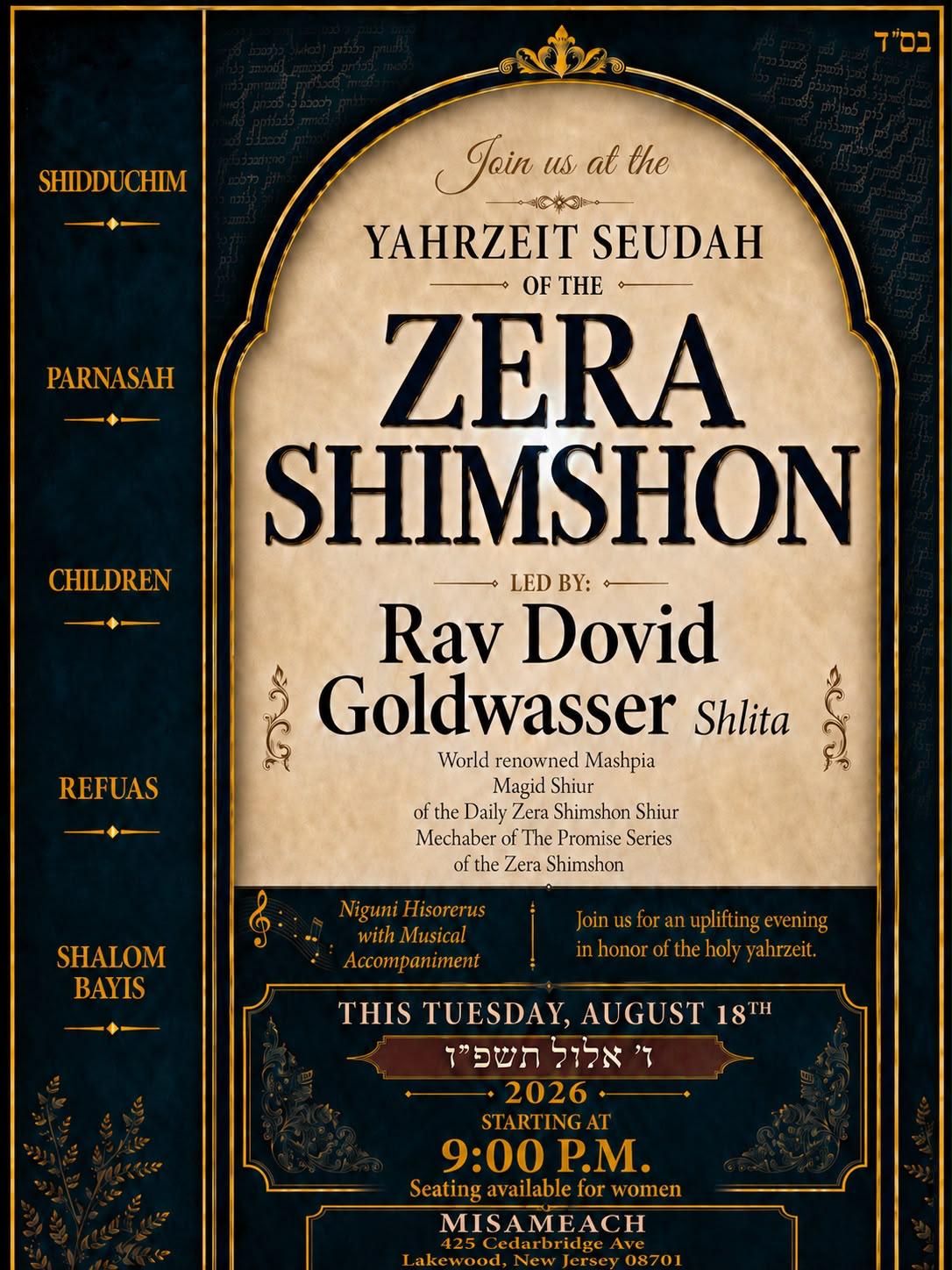
Ruchim aboim b'shem a'shem, what a great sluice it is throughout the entire world on virtually every continent. We are all united learning the Torah of the Haley Gezera Shemshin. Our share is for a sluice in Rufua Shalayma from Miriam Devoira, Bas-Ester, Rabbanit, Simi Simcha, Bad Miriam, Yaakov Aaron, Ben-Malka Esther, Leah, Bas-Fega, Imbesur Oztavos, for Yisrael, Ben-Ester Masha. We learn in the Pasuk, Shalayach Tishalach Esa'em V'esabonim t'ikach loch, send away the mother bird and take the young for yourself. The madrush tells us that the fulfillment of the Mitzvah Shiloh Hakim hastens the arrival of Elioa Novi as we find the lotion of Shiloh. The Pasuk and Malachi says, Hineonochisholeach lochem eselioa Novi. The Zara Shemshin asks, what does the Mitzvah Shiloh Hakim have to do with the arrival of Mashiach? Rabbeinu quotes the Zohar, that when a person fulfills the Mitzvah Shiloh Hakim, sends away the mother bird. The mother bird is worried, has tsar, because she left behind the nest in her children. She wanders from place to place. The Malach, appointed over all the birds, is deeply pained by this and asks Hashem for mercy. Then Hashem is filled with Rahamim and says, if this Malach is asking Rahamim for the bird over which he is appointed, I, the merciful father, the avarachaman, should certainly have mercy on my children. Woe is to me that my Beisameekdosh is destroyed. What caused this great compassion in Shomaim? Shiloh Hakim. Through this, we can understand how this Mitzvah brings close the coming of Mashiach. The great sonic of bells, Rabbi Yeshua, had a severe illness. He was advised to go to Vienna, where there was a specialist, where he would undergo a serious operation. He went. As the Rebbe was lying on the operating table, the specialist entered the room. The doctor was getting ready to begin the procedure. The Rebbe asked the doctor, tell me, do you believe in Hashem? The doctor replied, yes. And with that answer, he picked up his instruments and was about to begin the operation. As the doctor had raised the knife to begin the operation, all of a sudden, the Rebbe asked the doctor another question, do you believe in Mashiach? To that the doctor said, Rebbe, no. I've heard that Mashiach is supposed to be a poor man. He's gonna ride into town on a donkey. How will this poor man ever be able to cast fear and awe over all the nations of the world? With that, the Rebbe, whose eyes were lowered during the conversation, now fully opened his eyes, engaged upon the doctor. With that one look, the doctor began to tremble and the surgical knife dropped from his hand onto the floor. The Rebbe said to the doctor, look at me. I'm an old sick man. I'm lying under your knife. And yet, look at the awe and fear that I was able to inspire in you. Can you imagine the awe and fear that will be cast on the nations when the Melah Moshiach will descend on this world? With that, the doctor lowered his head and said, with a heart full of chuva, I believe. The operation was successful. The doctor grew close to the Belzerabbe and eventually became one of his most prominent chassidim. I would like to take this opportunity to invite all of our listeners, all of our Meshtaatvim, men, women, everyone, to the Suda in honor of the yard site of the Zara Shimshin. It's going to take place Bez Zashem tomorrow night that's Tuesday night, Vov Elul, August 18th at 9 p.m. in the brand new Mesamech headquarters at 425 Cedar Bridge Avenue, 425 Cedar Bridge Avenue in Lakewood. There will be a beautiful Suda, music, Ngunehis Ayrus, Divre Tyra, common partake of the school of the Zara Shimshin. It promises to be a very, very special evening. May it be a excuse for everyone, big brachas, big hatzlacha in all areas Ruchnius and Ghashmius and an alias Neshama for Rabbeinu. Bez Zashem Yesporach. We will be continuing with our Sira Nazara Shimshin. I wish everyone may umka deliba besvara ustavais, yashuais, venechomais.
📖 Read this voice note
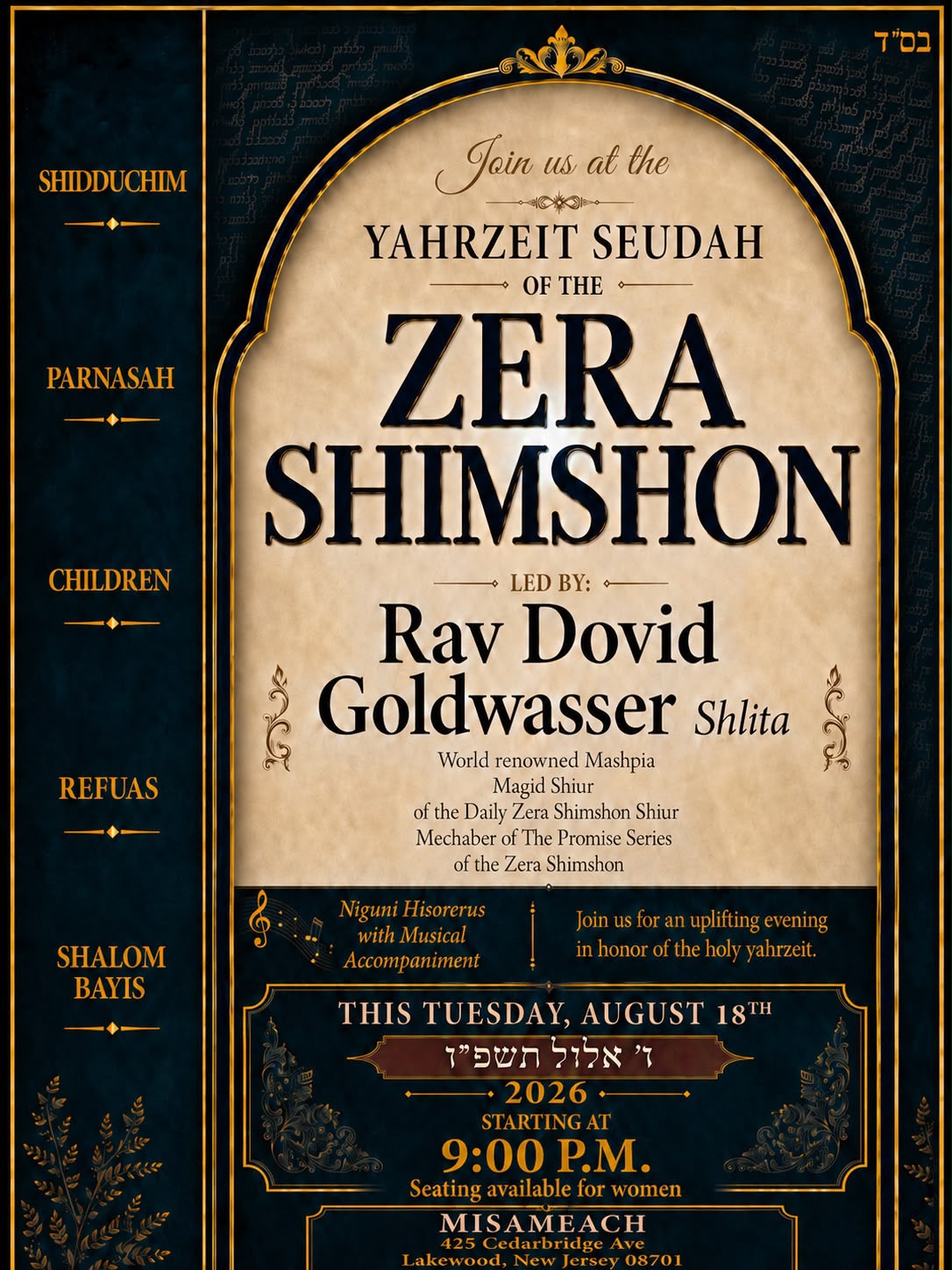
Ruchim habo'im b'sheim ha'Shem What a great squsit is that throughout the entire world on virtually every continent, we are all united learning the Torah of the Haley Gezer Hashimshin. Our share is for a squsit rufua shalaymo, for Miriam Devoiro bas Esther, Rabbanit simisimchah bat Miriam, Yakov Aaron ben Malcha Esther, Lea bas Fega, and B'Sur Oztavos for Yisrael ben Esther Malcha. Tonight, B'ez z'Hashem is the yard site of Rabbanu, the Zehra Hashimshin. I want to take this opportunity to invite everyone, men, women, all of our mishtatvim, to the Suda in honor of the yard site of the Zehra Hashimshin. It's going to be tonight, B'ez z'Hashem, at 9 p.m. At the brand-new headquarters of Miss Ameyach, 425 Cedar Bridge Avenue, 425 Cedar Bridge Avenue in Lakewood, New Jersey. There's going to be a beautiful Suda, Divre Torah of Rabbanu, musical accompaniment, Ngunahis Ayris, common partake of the school of the Haley Gezer Hashimshin. I would love to meet you and to spend a couple of minutes. It'll be a squs for everyone, and may it be an alias nishama for Rabbanu, the Zehra Hashimshin. We learn, shaleach te shalakhe s'aim, ve'esabonim t'ikach loch. Send away the mother bird and take the young for yourself. We learn in the Medrish that there are mitzvahs that the schar is honor. There are other mitzvahs, the matanschar is riches. What is the matanschar? What is the reward of the mitzvah of Shilu Acha'keim? Hashim says, anin oisayn lachabonim, I will give you children. As it says in the pasuk, ve'esabonim t'ikach loch. What is the connection between the schar of children and this mitzvah? The Medrish and Dvarim Rabba note something beautiful. If a person is m'kaim this mitzvah, the mitzvah of Shilu Acha'keim, it hastens the coming of Mashiach. Where the Loshan of Shilu Acha'keim is also used in Malachi, it says, hinayonochisholeachlochem es elioa novi. We learn in the fourth parake of Yuvamos, e'im ben-david ba, ben-david will not come ad shiichlo kola nishamosha beguf, until all of the nishamos that are in that special place in Shemayim called Goof will have descended and been born on earth. Since the reward of this mitzvah is that it hastens the coming of Mashiach, and because of that more children will be born into the world so that all the nishamos can be brought to life. I was recently called to be mishtatif at a Brismila. During the Brists, the Aviyah ben, the father, came over to me and said, I would like to tell you something very special. I said, please. He said the name of the child was after an elderly man, Azokin Muflug, who was a very special person. In the last couple of years of his life, he had it a little bit difficult. One of the things that bothered him was that he wasn't able to hear, lo, aleinu ba'okob eis Yisrael. However, it was something miraculous. When it was time for our Zara Shem Shinshir that he participated in each and every day, he would make great achonos, he would wash his hands, he would set up his chair, he would sit by the table waiting well in advance of the sheer. And when the sheer came on, miraculously, he was able to hear every word. May the scousse of the Zara Shem Shinshir be made in over all the mishtafim and all of Clou Yisrael. Bezuz Hashem, we will be continuing with our sheer in the Zara Shem Shinshir, I wish everyone may umka delibba, besuras tavais yishua'is v'nachomais.
📖 Read this voice note
What a great Schuss it is that throughout the entire world on virtually every continent, we are all united learning the Torah of the Helig-e-Zehra Shem-Shin. Our Shia is dedicated for a Schuss in a Rufua Shalaymo, from Miriam the Vajra Bas-Ester, Rabanit Simi Simcha Bad Miriam, Yaakov Aaron Ben-Malka Esther, Ahuva Libba, Bas-Sora Leia, Leia Bas-Fega, and Besoros Tavahs for Yisrael Ben-Ester Masha. On this great day of the yard site of the Zehra Shem-Shin, I would like to bench all of our Meshdatvim, all of our listeners, all of those that partake in the daily Shia, with Brocha Vahatslocha, in Ruchnius and Gashmius, Parnos and Metsuya Berevach, Shalom Baes, Rufuos and Yishuos, all the children that go by the way of the Torah, and Sheduchim in Besoros Tavahs for all of Klaus Yisrael. We learn in the Pasuk, Lo Ava Hashem Lo Kecha, Lishmoa El Bilam, but Hashem didn't want to listen to Bilam, Hashem transformed the Klala into a Brocha, as it says, because Hashem loves you. The Gemarins and Hadron, Dav Kufay, learns in the name of Rabbi Bar-Kahana, all the Brochas that Bilam gave ultimately reverted to Klalus, curses, because of the Mid-Isadin on Klal Yisrael. However, there was one curse on the Bote Knessios, the Bote Midrashos, on the Shuls, that was transformed permanently. We learn from the fact that the Pasuk says, Ha Klala Livracha, in the singular, that it was only the Brocha of the Besmedrish and the Besakneses that would be permanent. The reason is, because the Brocha that Yitzchok gave over to Yaakov contained the famous words, Ha Koyl Ko Yaakov, Vah Yodayim Yidei Asov, as long as the voice of Yaakov reverberates in the Shuls and the Bote Midrashos, then the hands of Asov will never be victorious. This Brocha is here forever and cannot be changed. It was immediately after the Holocaust. There were survivors, Sheresa plei to Yidin, that wanted to Daven. They looked for places that had not been destroyed. Perhaps the Shul was still standing or partly standing. There was one man whose father had donated several things in the Besmedrish. The father was Nere Galchidush Hashem. However, the son wanted to know if there was a memento, if there was a Zechir of his father. They began looking throughout all of the city. All of a sudden, somebody said that he had seen the parochas for the Arun Kodesh, that the father had given. It was in one of the houses that was taken over by the Nazis Yemachshamam. The man ran and he indeed found the parochas that his father had given. However, the parochas was being used as a bedspread, as a cover by the Nazis. Immediately he had the shaila. Were the Nazis metame, did they defile the parochas and it could not be used? Or was it possible that it could be reinstated? They went to the great Goyn, Rebaphraim Oshri, Zechertzadik Kodeshvatar Livrocha, and they asked him the shaila. Reb Oshri heard all of the details and said the following. The parochas never loses its Kodesh. Something that is Kodesh does not lose its holiness. Take that parochas, prepare it, and put it back where it belongs adorning the Arun Kodesh. It was to restore the crown to its former glory. We will be continuing our share in this our Asimshin. I wish everyone may umka deliba, besoros tavais, yehshuais, nechomais.
📖 Read this voice note
Rukhim m'aboim b'sheim ha'ashem. What a great s'chuss it is throughout the entire world on virtually every continent. We are all united learning the Torah of the Hedegazirah Shimshin. Our Shia is dedicated for a s'chuss in Rufua Shalayma, for Homa bas Javahir, Miriam Deva'iro bas Esther, Rabanit Simi Simcha bat Miriam, Yaakov Aaron bin Malke Esther, Ahuva Libah bas Sora Le'ya, and Le'ya bas Svega, Bishur Oztavahs, for Yisro'el bin Esther Masha. We learn in the pasuk, U'bos ala ko'in, you shall come to the ko'in, and you shall say to him, I declare today to Hashem, that I came to give the land that Hashem swore to our forefathers to give us. Rashi Akodesh says, V'y'amato e'ilov, and say to him, She'en ha'akka fai t'oyva, you are not ungrateful for all that Hashem has done for you. What does this mean that a person should say this? His mass improve that he's bringing b'ku'rim. Why does he have to say this? This Hashimshin answers that according to the mitzvah, the ko'in has to place his hands underneath the hands of those that are bringing the b'ku'rim, and then he waves the b'ku'rim. This is the ikr-tenufah, the waving of b'ku'rim. To b'mechavin, to hold back the ruchoy swows, the bad winds, and the rain, that which might be harmful. Therefore, V'amato e'ilov, She'en ha'akka fai t'oyva, say that you are not ungrateful. As most of the Chachme'ateva, the secular scholars, say that these ruchoy swows, the bad doves come from the seven planets in the twelve mazollos. A person might say that his blessing in the field or in the vineyard, that year, is not from the field of the ko'in, but rather Teva or mazel. Therefore he is warned, V'amato e'ilov, Say to him, that you are not ungrateful for all that Hashem has done for you. An elderly woman once appeared to the Chasamsoi for a dream. She told him that she had cared for him for the first three years of his life. Now she had no one to recite Kaddish for her. She noted that in Shama'im he was held in very high esteem. His divritara were greatly revered. She gave to him her name and her father's name. The woman requested that the Chasamsoi should say the Kaddish for her. From that day onward, the Chasamsoi faithfully recited Kaddish for her every day. He had strong feelings of akhara satav, appreciation for all the care that she provided him. A while later, she reappeared to him in a dream. She was shining with brilliance. She told him that he no longer had to say the Kaddish. The objective had been achieved, and her Neshama had ascended on high. Be'ezur Hashem Yisbarach, we will be continuing with our Shire Nisera Shimshin. I wish everyone may umka-de-libba, besurah-stavahs, Yishuahs v'nechomahs.
📖 Read this voice note
Bruchim aboim b'sheim ashem. What a great source it is throughout the entire world on virtually every continent. We are all united learning the Torah of the Hela Gazerah Shemshin. Our share is for a source in Rufua Shalema, for Homa bas Javahir, Miriam Davaido, Bas Esther, Rabanit Simisimcha, Bat Miriam, Yakov Aaron, Ben Malka Esther, Lea Basvega, Imbesur Oztavos, for Yisrael Ben Esther Masha. We read in the Pasut, Baruch privit nacho, ufri ad moscho, ufri vem techo, Shkar le fecho ve astroi so necho, Blessed shall be the fruit, the fruit of the ground, the fruit of your animals, the offspring, the flocks, the sheep, Blessed shall be your fruit basket and kneading bowl. There are Shemshin comments on the sequence of the brachos. First, it talks about the children. Then it talks about the produce of the land, the animals. Then at the end, the bracha of your fruit basket and your kneading bowl. However, by the clullus, by the curses lo alayno, the psukim read a little differently. Baruch privit nacho, ufri ad moscho, The sequence lists first the basket and the kneading bowl, then the children, the produce of the land and the animals. Why is this so? The tabernik subah slurns, Amravuna berch sabayis beruba. The bracha of the house is in the abundance of its residents, meaning the more people, then the bigger the bracha is in the home. It's explained that since there are many people, the mazal is better. Therefore, as our Shemshin says, when Hashem gives the brachos to Benay Israel, first He benches them with a family, so there should be a big source of bracha. Afterwards, Hashem gives the bracha to have the baskets and the bowls, because it is affected by the bracha that's already there from the Meshpacha. There are those who sometimes worry additional children will create financial hardships. However, in reality, every child brings with him the beautiful gift of karnasa. The great saddik, Ravitsha Kaduri, had great concern and love for every child, for every person. One time, there were a group of secular Jews, and they came to Ravitslok for a bracha. He gave everyone a warm bracha. One of the members of the group was a little bit upset, and he asked Rav Kaduri, why he had given another man in the group a bracha? He said, the person's not religious. Ravitslok smiled and responded with a bewildered look. I don't understand your question. I am more than happy to give a bracha to a fellow Jew. Besides, I gave him a bracha that he should keep Shabbos. I would like to inform the oylem of the Beshura Tava that the new book, The Promise of the Zarashimshin on Yom Noroim, is now in the stores all over the world. The Saffer contains inspirational thoughts, the Hidushim of the Zarashimshin on the Yom Noroim, inspirational stories, first-hand stories. It is a Saffer that you can keep with you throughout the days of Elo, Rosh Hashanah, Asersi Mechuva, Yom Kippur, and it also has Torahs on Sukkos and Simchastaira. Included in the Saffer is a special section on Tvilos, Tvilos for Rosh Hashanah, for Asersi Mechuva, for Yom Kippur, for Sukkos, and also special Tvilos for Tsuva. Everyone, all the Mistaatrim, all of those that learned the Zarashimshin throughout the entire world, it is a Saffer that belongs to you. In the name of God, we will be continuing with our Saffer and Zarashimshin. I wish everyone may Um Kedalibah in the form of Tava, Jesus, and the Chomeis.
📖 Read this voice note
Rukhim a boyim bisheim ashem, what a great schuss it is that throughout the entire world on virtually every continent, we are all united learning the Torah of the Haley Gezer Hashimshin. Our share is dedicated for a schuss in Rufua Shalaymo, for Homa, Bas Tzabahir, Miriam Devoira, Bas Esther, Rabanit, Simi Simcha, Bat Miriam, Jacob Aaron, Ben Malka Esther, Lea Bas Fega, and Bishur Oztavahs, for Yisrael, Ben Esther, Masha. We learn. We learn. We learn. We learn. We learn. We learn. We learn. We learn. What is the word Mishom? It could just as easily said, Yekabetschah, will be gathered, and if it already says, Mishom yekabetschah, why do we need yekachechah? Veru quotes the Gamar and the Gila, Kimna fel tipa lefano. Yekachachom im setohamon, if you have begun to fall before B'nai Yisrael, you will continue to descend to the depths. Doresh Rebihudabariloy, Rebihudabariloy asks the question, Shtei nefilo sallolulama, why are there two nefiloys, two ideas of falling here? Om Ruloy, why? Um Azu, this nation is compared to Afar, to dust and dirt, and it is also compared to kochavim, to the stars. When B'nai Yisrael falls, they fall to the dirt. However, when they rise, oyleinat na kochavim, they will rise to the stars. Is there a shemshin continues with the Gamar and Brakhus? Om Rebihudabariloy, Rebihudabariloy says, mi b'nai malo nemar non baashrei, why is there no posuk beginning with the letter nun in ashrei? The reason is, it because it contains an illusion to the downfall of the enemies of Israel, which is the euphemism for Klaus Yisrael, as it says, naflah she has fallen and will no longer rise. This is the way the posuk is understood, im yiyen i dahakha, if Klaus Yisrael reaches such a level that they fall to the last shahr of Tuma, there is no lower level to which they can descend, then specifically from there, kum besulas Yisrael, b'nai Yisrael will rise up, it is the last yuridah that is our reason for being raised up to Shemaim. That's what it means mi shum, even if the person reached the lowest level in life, Hashem will redeem him, not in spite of the low level, but because of the low level, Hashem will redeem us from our sins, we will bizochhe tuslicha mechila en kapara. The great sadiq Ram Shlomo of Kaleen says, if somebody has sunk into the mud, they're deep into the dirt, and you want to take them out. Don't think it's good enough just to extend your hand and try to raise him up. You have to go down with him, into the mud, into the dirt, into the pit. There you have to embrace him with both hands and raise him up together with you. Be'ezur Hashem Yisbarach, we will be continuing with our shirinazirah shimshin, I wish everyone may umka de leba, besura ustavais, yishuais, v'nachamais.
📖 Read this voice note
What a great source it is that throughout the entire world, on virtually every continent, we are all united learning the Torah of the Hélik-e-Zaroshimshin. Our share is for a source in Rufua Shalaymo, for Homa bas Javahir, Miriam Devoira bas Esther, Rabanit Simi Simcha bat Miriam, Yaakov Aaron ben Malka Esther, Lea bas Vega, and Visarostavos for Yisra'el ben Esther Masha. Today's share is dedicated by Midwood Custom Framing. Midwood Custom Framing is on Avinuem, 1916 Avinuem. The proprietor is a very close, you did of mine, Rebjev Resnick. They are preparing right now in order to be ready for Yomtov. Anyone that would like to have custom framing. They do a beautiful job. If you want to take the children, they have all kinds of crafts, very interesting and advanced crafts. It's open all the time, any time I've ever passed by they've been open. Please don't hesitate, go in and see Jeff. He will explain to you many different things about artwork and enhancing the home, enhancing the environment. The telephone is 718-934-8800. May Umka Dileba, I wish Jeff and the entire Midwood Custom Framing a lot, a lot of Hatzlacha. We learn in this era Shemshin, Parshis Nitzavim, Dvarim Raba, Omorakolish Baruchu, Hashem says, Im berachta satayra, if you may bercha satayra, the brahava satayra, for yourself, you are mevarich, you will be blessed. This is our Shemshin asks, what does this mean? When a person makes a brahava over the satayra, it's apparent that they have anah, they have enjoyment from it. And if the person has anah, it is a semen that the individuals involved in learning Torah with a degree of sincerity. When a person is oisek betorah with sincerity, then the Torah has a power to protect and to save. Like it says in the Gemara in Sotah, Magno Matzla, it protects us and saves us. Certainly the individual will be saved from the Yetzahara. That is the tavelin, the antidote, most helpful against the Yetzahara. With it, a person will not come to kheit or oven, any type of a sin. As a result of the person staying clear of kheit and oven, all good will come to the individual. They will be blessed, their family will be blessed. In fact, Klaus Yisroel will also receive the brahava. There was an individual that came up to the great Sadik, Rebinaftali of Rupschitz. And he asked the Helya Rupschitzer, tell me, where does the Yetzahara live? The Rupschitzer answered, any place where you think he doesn't live, that's where he's living. Be'ezir Hashem Yisbarach, we will be continuing with our shirin, as our Hashimshin. I wish everyone may umka da liba, be'ezir astavais, yeshuais, venechomais.
📖 Read this voice note
Prukhim a boyim b'sheim a shem, what a great skhustid is that throughout the entire world on virtually every continent. We are all united learning the Torah of the Helig-e-Zarah shimshin. Our shiir is dedicated for a skhustid rufua shalayma, for Homa bas-javahir, Miriam davoro bas-aster, Rabanit simi simcha bat Miriam, Yakov aran ben-malka ester, Leia bas-vege, Imbesoroz tavaz, for Yisra'el ben ester mashah. We read in the poshuk, u b'charta b'chaim, le mantikh ya'a tavaz a recho, you should choose life, for yourself, for your children. This our shimshin notes that the Mufarsim ask, what is the reason that the Torah ktosha had to tell us, u b'charta b'chaim? It's an obvious choice to choose life, what's the alternative? Rabenu cites his father, who says the following, the ikr chiddish of this poshuk is that a person should choose to go in the derach hachaim, once the person chooses the path of life, then a shem will help, that his thoughts and intentions should be fulfilled and acted upon. Once as it says in the Talmud-Bavli mesachas makus, bederach shodum rotsa leylech bo, molichin oiso, in the way that a person wishes to go, so will he be led in that way. That's what the poshuk is saying, it is the obligation of every person to choose the correct derach, the derach that is good, even if he cannot yet do it correctly. Later he will choose the derach hachaim, he will have the syat and the shmaya, and the shem will help him in his journey. In the neighborhood of the great saddic rabishayah of Prague, there was a certain merchant who used to sell cakes every day. The merchant did not have the gift of sight. He would stand outside in the cold, he would stand outside worrying whether somebody might take his goods and try to steal from him. One time there was an officer that came and took all of his cakes away. When this happened, the oni began to cry uncontrollably. At that moment, the great rabishayah was passing by and asked him what happened, and he told him, rabishayah then got all of the money and paid the poor man for all of the damages, all of the stock that was taken. From that day on, rabishayah always waited till he saw that merchant, and when the merchant would pass by with a syrah, with a merchandise, immediately he would buy all of the cakes that he had to sell. One time a person who was closer to shayah said, why do you do this? You could just give him a monthly stipend. You could pay him each month. Now you have to go in the tiracha of waiting for him, and then the oni has to come with the cakes and you buy it from him. Isn't that a lot of extra work? Rabishayah said no. This merchant, he believes with his whole heart that he is a successful merchant, and each day he earns a living with respect and dignity. If he does not have the light of his eyes, at least let him have the simcha of his nefesh, that I don't want to take away from him. We will be continuing with our shirinazara shimshin. I wish everyone may umka de liba, besvaraus tavais, yishuais venechomais.
📖 Read this voice note
We are all united learning the Torah of the Helig-e-Zera Shem-Shin. Our Shire is dedicated for the Shlush-in-Rufua Shalema for Homa Bas-Javaher, Miriam Dvaira Bas-Ester, Rabanit Simi Simcha Bat Miriam, Yakovaron Ben-Mauke Esther, Leia Bas-Fega, and Bessaros Tavos for Yisrael Ben-Ester Masha. We learn in the parashah concerning Chuvah. It says in Meseches Yuma, Yochit Sh'osot Chuvah, just one person that does Chuvah, Gedoylet Chuvah Sh'bishvir Yochit Sh'osot Chuvah, Moichlin Lo Al-Kololum Kuloy, that because of one person that does Chuvah, the entire world is forgiven. Is there a Shem-Shin asks, how is it possible that one person does Chuvah and the entire world is forgiven, even if they themselves didn't do Chuvah? It is known that when we say Gedoy, we don't say Chatosi in the singular Lushan Yochit, but rather Lushan Rabim Chatanu, we have sin. What is the reason for this? All of Klaus Yisrael is one goof, one unified body. Each member of Klaus Yisrael is a specific limb or a part of the body. That being so, the arvas, the fact that we guarantee each other that we're responsible for each other, will help that the Chuvah should be Chuvah Shalaymo. If a person doesn't pay their debt, but he has a guarantor, the areth then pays up the debt and the loyve is exempt from paying. When we do Chuvah, we are mizakah others, we have enabled others to do Chuvah as well. Because of that, we understand the arvas, the responsibility that we have for Klaus Yisrael. One time, the granddaughter of the great Rabbi Yisrael of Viznes asked her grandfather, why didn't you eat anything from what I prepared for you? The Rabbi answered her, if you would sit all day like I did, and read all of the kwitlach, all of the notes that everybody brought to me, the things that they need, the tsarists that they have, the Yeshuas that they're waiting for, I guarantee you you would not be able to eat either. Bez Zashem, we will be continuing with our Shire Nizar Hashimshin. I wish everyone may umka deliba, besura s'tavaz, Yeshuaz ve nechamaz.
📖 Read this voice note
Bruchim habo'im b'sheim ha'Shem, what a great scousinist throughout the entire world on virtually every continent. We are all united, learning the Torah of the Haley Gazerah shimshin. Our share today is for a scousin Rupua Shalayma, for Homa, Bas Javaher, Miriam Dvaira Bas Esther, Rabanit Simi Simcha Bat Miriam, Yaakov Aaron Bel Malka Esther, Lea Bas Fege, and Bessaros Tavos for Yisrael Ben Esther Masha. The Tikhunei Zohar tells us that whoever has the proper kavana, when he's m'kayim the mitzvah, that Makhshovah that the person has, goes straight up to shemaim. However, a person who does a mitzvah and disliking the proper kavana, even though the fulfillment of the mitzvah itself is of course considered to be a great s'chus, nevertheless it does not reach the level of a mitzvah that is done with the proper kavana and attention. When Bessaros blow the shayfar on Rosh Hashanah, and they have only in mind the fulfillment of the mitzvah, they are a zoha, that all the dinim are mystallic, they are absolved of any harsh judgements, as it says, Ola Elohim Bistrua, the din goes up, however, the person is still judged with the mitzvah of Gavura. However when Bessaros take the shofar in hand, their m'chavin to all of the special names of Hashem that come out from the shofar, and the deep kavanas of the shofar as well, that completely sweetens the judgement. That turns all the dinim into rachamim, divine compassion and mercy. In the words of the Zara shimshin, rachamim b'chasodim gedoylim, great mercy and great chesed, as it says, Hashem beko'u shofar. It is said that when the great Rebellos Rokeach, the author of the Miser Rokeach was on a ship, he was headed towards Eris Israel. All of a sudden, a storm broke out at sea, the ship began to toss and turn. All of a sudden, all of the passengers were put at great risk. Since Rebellos Rokeach appeared to be a very righteous individual, the passengers approached him and begged him to pray for their salvation. It happened to be the night of Rosh Hashanah. Rebellos Rokeach requested that his shofar be brought so that he could fulfill the midst of the day as soon as it was daylight. Indeed, as soon as the sky began to brighten, Rebellos Rokeach blew the blasts of the day, and after a short time, the storm abated, the winds subsided, the ship continued to sail on calm waters. On presenting this story to his tamidim, Rebsim Chabonim Pajisk explained, it was not the intention of Roveokeach that the shofar should be a charm or a school of the quietest storm, rather, when he saw that all the other efforts had failed and the ship would sink at any moment, the passengers would lose their lives. He wanted to do one more mitzvah before his nishama left the world. Even at that time of great danger, he forgot his own pain and suffering and only desired to be involved in a heavenly pursuit. It was that devotion, that kavana, that stirred the mercy of heaven, saving him and all the passengers from certain death. Be'ezus Hashem, we will be continuing with our share in this Arashimshin. I wish everyone may umka deliba, besuras tava, si'su'aisu nechamaizu.
📖 Read this voice note
What a great excuse it is that throughout the entire world on virtually every continent, we are all united learning the Torah of the Hale Gezer Hashemshin. Our share is given for a excuse in Rupua Shalayma, for Homa bas Javahir, Miriam DeVaira bas Esther, Rabanit Simi Simcha bas Miriam, Yaakov Aaron ben Malka Esther, Lea bas Fege bas Rostovos bas Yisrael ben Esther Masha. We learn in the Pasuk, Ashrei Haom Yoidei Surua, praises to the people happy are they who know the Shophers cry, Hashem baor ponachu ya lehun, Hashem by the illumination of your countenance, they walk. Does their Hashimshin ask, what does it mean ya lehun that they walk? He explains that a person is comprised of two halakim, two parts, the goof and the nefesh, the body and the soul. Sometimes an individual becomes wary, he sits down, he doesn't go. When he sits, it is only for the manuchah of the goof, the rest of the body. It is not for the nefesh because the spiritual part of the body, the spiritual part of an individual, does not tire, it doesn't need to sit. By ruchnius, there is aloshun halicha, there is forward movement, one continues every day to gain holiness in spirituality in ruchnius. That is why Klaus Yisrael shuckles by Limuratorin mitzuz by praying, we move back and forth. It is the chelik ruchni, the spiritual part in us that doesn't rest like a candle whose flame flickers and continues to burn. It happened to be that it was right before Rosh Hashanah, and the great Be'el Zarebe told his Chassidim that he wants to travel, it was in the evening, and they didn't understand where he was going. They all followed him, he traveled to the outskirts of town, there at the outskirts of town. They looked in a window of a poor little home, and they saw a man sitting by the table. He had a small cup of wine poured, and on the other side of the table there was a small cup of wine that was poured. The man took the cup of wine, he held it up, nobody could know what he was saying, but he was saying something like, I am mochal, I forgive, I am mochal, I forgive, and he drank the wine. He went to the other side of the table, he picked up that cup of wine, and he said again, I am mochal, I forgive, I am mochal, I forgive, and he drank that cup of wine. Afterwards he sang, and he was smiling. The Be'el Zarebe then left and went back with all the Chassidim to his synagogue, to his shul. All of them asked, Rebbe, what was this? What happened? We went this way, we thought we were going to see something great, and there was a man that took a little cup of wine and drank it, wish lechayim, took another cup of wine and wish lechayim. He said this man had unfortunately this past year become a little distant from Hashem, and the man was a little bit upset because things were not turning out the way he wanted, and he wondered why Hashem was not giving him all the brachos that he wanted. Right before Hashashanah he decided he's got to make up with Hashem, he got to make peace. How do human beings make peace with each other? They take a little cup of wine, they wish each other lechayim, and tell each other that they are mochal them, that they forgive them. This man sat down with Hashem on the other side and said, Hashem, please, I mochal you, anything that I said, anything, I didn't really mean it, Hashem, please be mochal me, and he lifted up the cup of wine for Hashem, and Hashem was mochal him. The Belzer Rebbe said, I never ever saw such holiness, such kedusha, such helikite as gaining atonement and forgiveness from Hashem in such a beautiful and simple way. Be'ezer Hashem Yisbarach, we will be continuing with our shirinazirah shimshin. I wish everyone may umka deliba, besorostavaz, yishuaz, and nechemaz.