Kosher Music App: Jewish Music by Genre and Artist, Approved First
A kosher music app plays Jewish music without the open site around it: every song approved before it appears, and women's singing kept to accounts set as a woman's. On LeHallel on 1 October 2026 the music came in 25 genres, from 8,581 English songs by 122 artists to 2,256 Chassidishe nigunim, with Moshe Habusha's 898 songs at the top. Free, in any browser, no account needed.

What people want from a kosher music app
Jewish music is the largest of the 13 subjects we measured for these guides. When we collected the searches Google and YouTube suggest on 30 September 2026, music gave 855 different ways of asking, more than any other subject. Among them: "jewish music app free", "best jewish music app", "jewish music without words", "jewish music for kids", "jewish music for shabbat", "jewish music radio" and "is music allowed in judaism".
Read together, those searches ask for four things at once:
- Only Jewish music they would choose, without wading through everything else.
- Men's and women's music kept apart, so a family can share one place.
- Nothing around the song: no comments, no feed deciding what comes next from the whole internet.
- Their own artists: the singers they grew up with and the new ones their children love.
This guide explains the kinds of Jewish music people look for, shows what one approved library actually holds (LeHallel's own counts, 1 October 2026, and pictures of the real screens), and ends with eight questions to ask of any music app before you rely on it.
The kinds of Jewish music, explained
"Jewish music" covers very different sounds. Knowing the names helps you find what you want, and helps you explain to a child why one shelf is fine for Shabbos afternoon and another is for a wedding.
| Kind | What it is | Approved songs | Good for |
|---|---|---|---|
| English songs | The catalog's largest shelf; despite its name, its most played songs are Hebrew songs by Ishay Ribo, and it holds 401 videos from Rabbi Shmuel Silber | 8,581 (122 artists) | Browsing widely; search by artist for English songs |
| Israeli songs | Songs from Israel, mostly in Hebrew | 7,202 (111 artists) | Families who daven and sing in Hebrew |
| Chassidishe nigunim | Melodies, often without words, sung together | 2,256 (69 artists) | Shabbos, a kumzitz, a quiet evening |
| Cantorial (chazzanus) | The chazzan's art: tefillos set to elaborate melody | 1,704 (19 artists) | Learning nusach, Yamim Noraim mood |
| Dancing music | Fast songs for simchas | 1,259 | Weddings, bar mitzvahs, Simchas Torah |
| Instrumental | Music with no singing | 1,205 | Background while learning or working |
| Mizrachi music | Sephardi and Mizrachi styles | 728 | Families with those traditions |
| Shabbos songs | Songs filed for Shabbos (it also holds 68 videos from a daf yomi channel) | 714 (70 artists) | Learning new zemiros before Shabbos |
| Acapella | Voices only, no instruments | 364 | Times when many avoid instruments (ask your rav) |
| Yiddish songs | Songs in Yiddish | 257 | Yiddish-speaking homes, grandparents' songs |
| Carlebach songs | Melodies of Rabbi Shlomo Carlebach | 197 | Kabbalas Shabbos, kumzitz |
A nigun, in the words of the Wikipedia entry on it, "is a form of Ashkenazi Jewish vocal music sung in group settings," often using "repetitive non-lexical vocables such as 'bim-bim-bam'... rather than with formal lyrics." That is why "Jewish music without words" is one of the most common things people type: they are usually looking for nigunim. Our guide to music for the Jewish year goes season by season, from Shabbos to Sefira.
What the library holds, by genre
LeHallel files its approved music under 25 genres. Here are the twelve largest on 1 October 2026, leaving out the podcasts and shiurim that are filed with music. These are LeHallel's own counts, the same ones its phone page shows.
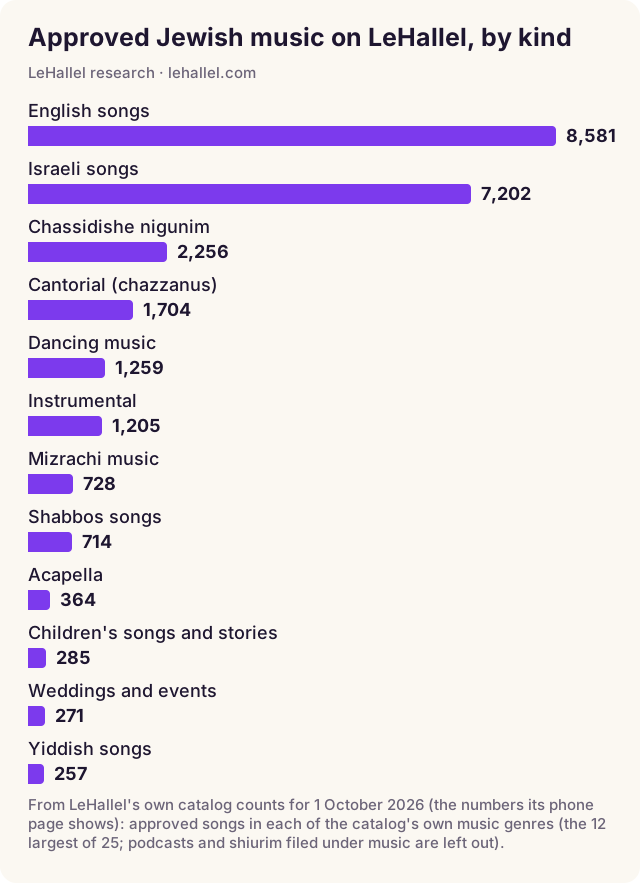
Two things stand out. English and Israeli songs make up most of the library, so a family that mainly listens to one of the two will find depth. And the smaller shelves are small: 197 Carlebach songs and 257 Yiddish songs are a good start, not a complete collection. If a niche is what your family loves, check it before you decide.
One caution about the genre names. Some of the smaller shelves are filed by artist, not song by song. On 1 October 2026 the "Chanukah Songs" shelf was Yossi Desser's 53 songs, the "Purim Songs" shelf was Yirmi G's 59 and the "Yamim Noraim Songs" shelf was Chaim Dovid Berson's 127, so each holds songs for other times of year too. The larger shelves are mixed in other ways: "English Songs" is led by Hebrew songs by Ishay Ribo and holds 401 videos from Rabbi Shmuel Silber, and "Shabbos Songs" holds 68 videos from a daf yomi channel. Treat a genre as a place to browse, and search by artist or song when you know what you want. Our guide to music for the Jewish year names real songs for each season.

The artists, each with a shelf
Most people do not think in genres; they think in singers. LeHallel's Every artist list opens with the artists who have the most approved songs, each with the years their songs span.

The twelve artists with the most approved songs that day were Moshe Habusha (898), Yaakov Shwekey (819), Mendel Markel (691), Yeshivat Netiv Aryeh (648), Yaakov Lemmer (599), Mordechai Ben David (553), Gilad Potolsky (446), Pianohands (372), Yitzchak Meir (360), Dudi Kalish (351), CKids (349) and Hanan Ben Ari (348). The list mixes kinds: a chazzan (Yaakov Lemmer), a yeshiva's own recordings (Netiv Aryeh), an instrumental pianist (Pianohands) and a children's channel (CKids) sit beside the best-known singers.
Two cautions about these counts, because a count filed under a name is not always that person's own. Yaakov Lemmer's 599 include many videos from the Amudim channel, such as songs by other singers, beside his own chazzanus. And Hanan Ben Ari's 348 include songs by MD Schwartz, such as "Hoshana" and "Ah Gutten Shabbos", which LeHallel's pages file under his name. When it matters who is singing, check the title.
Each artist's own channel is the place to find what is newest and to support their work. Several are linked at the end of this guide.
Men's and women's music
Many families, following the halachos of kol isha, keep women's singing apart: women and girls listen to it, men do not. How far this goes, and in which situations, is a question for your rav, and homes differ.
On LeHallel this is a property of the account, not a request to be careful. Women's music shows only on an account set as a woman's. Anyone else, including anyone who simply opens the site without signing in, sees men's music and music without singing. That means a family can share one library, and the screen a boy or a man opens does not hold what he should not be listening to.
Two honest limits. An account is only as right as whoever set it up. And no library decides what a person can find elsewhere on a device; that is a separate question, covered in our guide to filtered YouTube.
Ways to listen: an artist, a genre, the radio
Inside LeHallel's Music room there are four doors, and each fits a different moment:
- Artists, when you know who you want. The artist's songs open on their own shelf.
- Genres, when you know the mood: a Shabbos song, a nigun, something for dancing.
- Just came in: in the room's own words, the "10 newest approved songs".
- The radio, when you just want music to play. LeHallel describes its Kosher radio as "filtered Jewish music that just plays · sleep timer".
A shelf "For the season" sits in Everything in Music too. On 1 October 2026, during Sukkos, it offered Yamim Noraim songs (127), Shabbos songs (714), Sukkos songs (101), Chassidishe nigunim (2,256), relaxing music (175) and Carlebach songs (197).
Choosing a music app: eight questions
Whether you use LeHallel or anything else, these eight questions tell you whether a music app will hold up in your home. Ask them of the app itself, on the device your family will use.
- Who decides what is in it? A person, a standard, or simply whatever is popular?
- Is women's singing kept apart, and how? By account, by a folder, or not at all?
- What is around the song? Comments, a feed, suggestions from the whole internet?
- Does search stay inside? Type a few ordinary words and see where the answers come from.
- Does it hold your artists? Search for the five singers your family plays most.
- Does it fit your weeks? Shabbos songs before Shabbos, acapella for Sefira and the Three Weeks.
- What does it cost, and what happens if you stop paying?
- What can the device do besides? A clean music app on an open phone is still an open phone.
Questions people ask
What is the best Jewish music app?
The one that holds your artists, keeps out what your home keeps out, and decides by a standard you trust. Use the eight questions above on the device your family will use.
Is there free Jewish music online?
Yes. The artists' own channels are free to watch, and LeHallel's approved library plays free in any browser; its FAQ says "No card is taken anywhere on this site."
What is Jewish music without words called?
Usually a nigun (plural nigunim): a melody, often sung together with sounds like "bim-bim-bam" instead of words. LeHallel held 2,256 approved Chassidishe nigunim on 1 October 2026.
Are men's and women's music separated?
On LeHallel, by account: women's music shows only on an account set as a woman's, and anyone else, including anyone signed out, does not see it. What applies in your home is a question for your rav.
Is there a Jewish music radio?
LeHallel's Kosher radio is "filtered Jewish music that just plays", with a sleep timer, inside its Music room.
Where can I find cantorial music?
LeHallel files 1,704 approved cantorial recordings by 19 artists under Cantorial. Yaakov Lemmer, a chazzan, has 599 approved songs in the library in all, not all of them filed as cantorial.
Who are the most popular Jewish singers?
By approved songs filed under their names on LeHallel on 1 October 2026: Moshe Habusha, Yaakov Shwekey, Mendel Markel, Yeshivat Netiv Aryeh, Yaakov Lemmer and Mordechai Ben David (some counts include other channels' videos filed under the name). Popularity elsewhere may differ.
Does a kosher music app make my phone kosher?
No. It decides what plays inside it. What else the phone can open is a separate question for the phone itself.
Sources
- LeHallel, the Music room, Every artist and Everything in Music, opened in a real browser at iPhone size on 1 October 2026 (the pictures above).
- LeHallel's own catalog counts for 1 October 2026: approved songs per genre, artists per genre and songs per artist (the chart and the table above).
- LeHallel's own catalog counts for 1 October 2026: the artists filed under the Chanukah, Purim and Yamim Noraim shelves.
- Wikipedia, Nigun (read 1 October 2026).
- Wikipedia, Jewish music (read 1 October 2026).
- Wikipedia, Hazzan (read 1 October 2026).
- YouTube, MBD Official, Yaakov Shwekey, Mendel Markel, Hanan Ben Ari Official: each channel named by YouTube's own record of the artist's top approved videos (checked 1 October 2026).
- Wikipedia, Tzniut: female singing voice (kol isha) (read 1 October 2026).
- LeHallel, FAQ (read 1 October 2026): "No card is taken anywhere on this site"; every video "plays through YouTube's official player"; "YouTube may show its own ad on some of those videos."