Music is where the filtering usually breaks
Most families hold a line on video and then quietly give up on music, because music lives on the same open sites and the search box there answers absolutely anything. You wanted one song. What you got was a search bar, a sidebar and an autoplay queue.
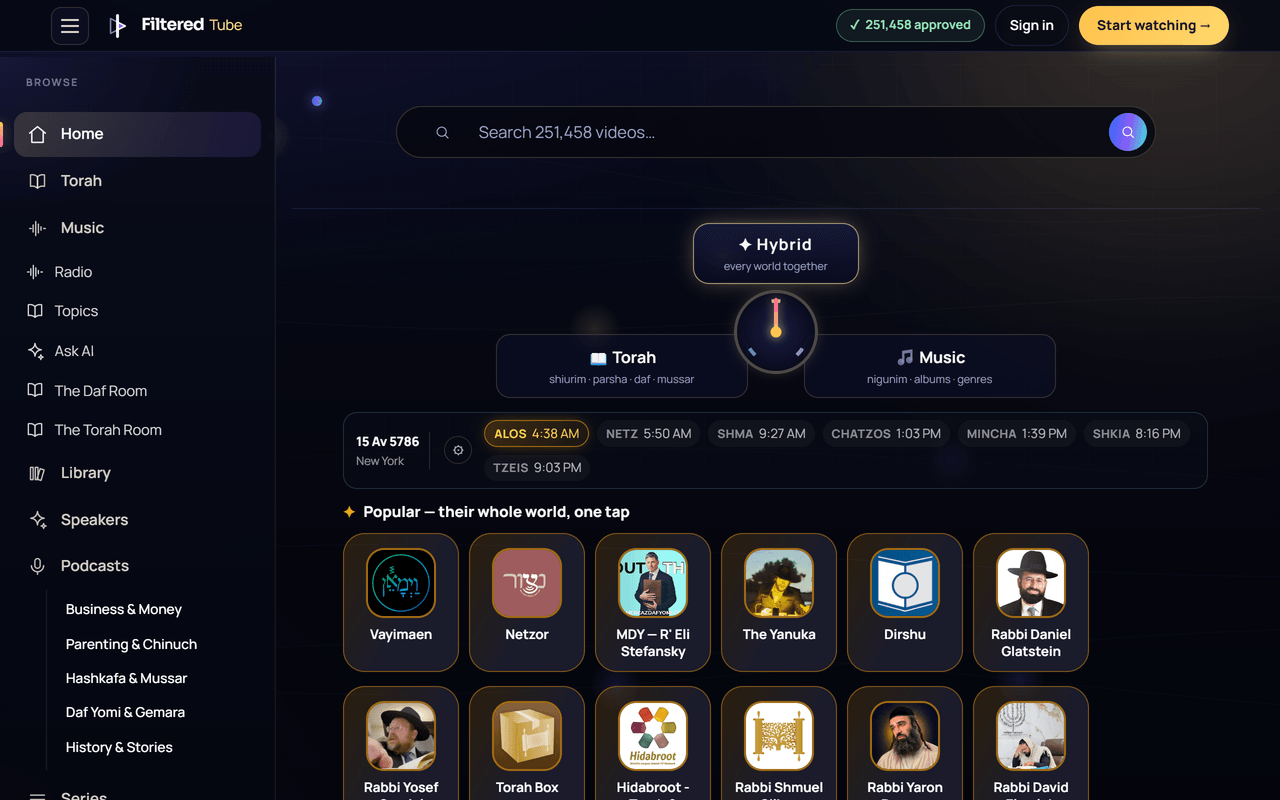
The music here sits in the same approved room as everything else. Every track was judged against the same written standard before it could appear, and the room has no ads, no comments and no feed.

Separated by account, not by asking nicely
Men's and women's music are separated at the account level. That is a setting on the account, not a request to be careful, and not a folder somebody has to remember to avoid.
It means the family can share a platform without every person in the house having to navigate around what they should not be listening to. The account decides. The screen just reflects it.
Built for how families actually listen
You can listen with the screen off, which is how most music actually gets listened to — driving, cooking, working. There is a kids' mode behind a PIN, so a child opening it lands somewhere built for them rather than somewhere built for you.
And there is a shelf that follows the week, so the parsha and the season are there without going looking for them.
Real music, playing now
Approved and in the library today:


The artists have real homes
1,986 artists and speakers have their own organized page here — the actual body of work, not whatever a machine surfaced this week. If your family follows somebody, you go to their page and it is all there.
That is the part people are usually surprised by. Filtering is supposed to mean less. Organized properly, it turns out to mean you can finally find things.
It also means a concert stays a concert. A full performance is here as the full performance, not sliced into a dozen clips with the best two minutes pulled out to be used as bait.
The thing that actually goes wrong with music at home
Ask parents where their filtering breaks and it is almost never the video they sat down to watch. It is a child looking for one song, on a device, on the open site, at an ordinary moment on an ordinary afternoon. The search box is the hole. Everything else is downstream of it.
An approved library closes that specific hole, because the search box only has approved material to answer with. The child searches, finds the song, plays the song. Nothing else was ever reachable from there, so nothing else had to be blocked.
That is a quieter kind of protection than a filter that pops up warnings, and in practice it works better, because it never asks a child to be the one who resists.
What it does not pretend to be
It is not a filter for your phone. It is a library. If the open internet is reachable on a device, having this installed does not change that — those are two separate jobs, and we would rather say so plainly than let anyone assume otherwise.
It is also not a claim that music taste is settled. Families differ, and a platform standard is a floor rather than a psak for your house. What it does mean is that nothing arrived on the screen without somebody applying that standard first.
At a glance
Key takeaways
- Every track is approved against the same written standard before it can appear.
- Men's and women's music are separated at the account level, not by asking.
- Screen-off listening, a PIN-protected kids' mode, and a shelf that follows the week.
- No ads, no comments, no autoplay into something unapproved.
- 1,986 artists and speakers have their own organized home pages.
More in Jewish Music, Properly