Kosher YouTube — what it actually means
A kosher YouTube is a way to get the good of a video platform without the site that normally surrounds it.But the phrase covers two opposite approaches, and which one you are being offered decides how it behaves the day it gets something wrong. This page explains both, honestly, including where each one leaks — and what “approved” really involves before a video is allowed on the screen.
Two opposite things wear the same name
The first approach starts with the whole open site and tries to hide the parts that are a problem — a restricted setting, a parental control, a filtering app. Everything is still there; some of it is covered. The feed still runs, search still answers, comments are still underneath, and the next video still starts by itself.
The second starts from an empty room. Nothing is present. A video appears only because a person put it there on purpose, after measuring it against a written standard. There is no open site behind it to leak through, because there is no open site involved at all.
Both get called kosher. Only the second can answer, about any particular video on the screen, the question why is this allowed to be here?
Why the direction of failure is the whole decision
Nothing never misses. Any honest person building either kind will tell you that. So the real question is not whether a system will be wrong — it is what happens when it is.
When a hide-the-bad system is wrong, something bad reaches your child. When an approved library is wrong, something good is missing and you ask us to look at it. One of those is a phone call. The other is a conversation you never wanted to have. That difference is not a detail; it is the entire reason to choose one over the other.
What approval involves before a video can appear
Approval here is not a category and not a checkbox. Every video is judged against one written standard, the same one for everybody, and the judging happens first— not after a complaint, not after somebody’s child already saw it.
What that rules out matters as much as what it allows. A video is not approved because it is popular. It is not approved because the person who made it is well known. And the standard is not quietly relaxed when the catalog feels small, because a standard you bend when it is inconvenient was never a standard.
The site around the video is most of the danger
You could approve every single video and still have the problem, because on an ordinary video site the danger is usually not the video you clicked. It is the rail down the side, the thing that autoplays next, the comments underneath, the thumbnails on the way in, and a search box that will answer anything at all.
So none of that exists here. No suggested-video rail. No comments. No community tabs. No advertising from us. Search returns only what passed review. The room is quiet deliberately.
What is actually inside
386,335 approved videos, of which 359,785 are Torah— shiurim, daf yomi, parsha, mussar and machshava — alongside Jewish music and children’s videos. They come from 518 channels, and 1,986 speakers and artistseach have their own organized home page, so a person’s work is together in one place instead of scattered.
You can listen with the screen off, change the playback speed, and there is a kids’ mode behind a PIN. There is a shelf that follows the week, so the parsha and the season are there without hunting for them.
The honest limitations
An approved catalog will sometimes be missing something you want. A shiur went up this morning and is not in yet. A speaker has forty videos in and twelve still being looked at. That is real, and it is the price of the direction — we would rather say it plainly than promise a filter that never misses.
And this is a library, not a filter for your phone. If the open internet is reachable on a device, having an approved library on that device does not change that. They are two different jobs, and anyone selling you one as the other is doing you a disservice.
What a kosher YouTube looks like
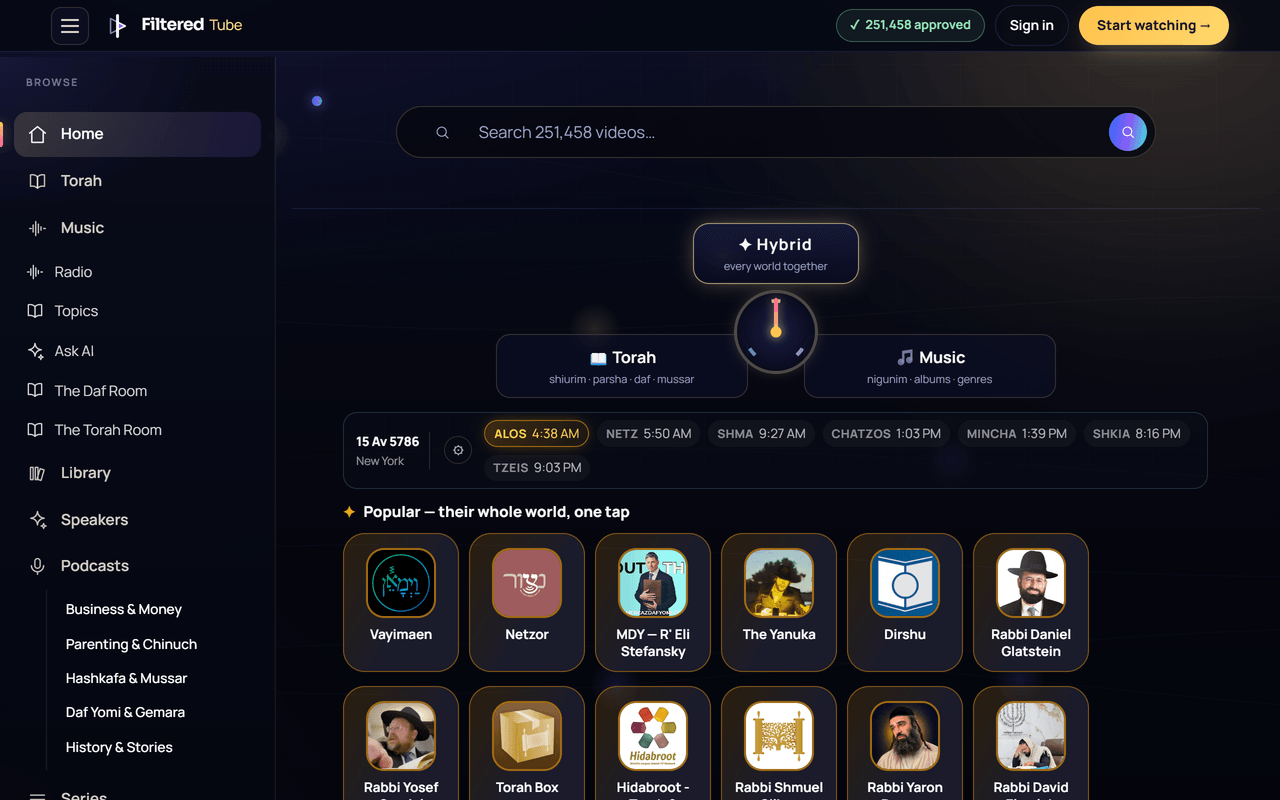
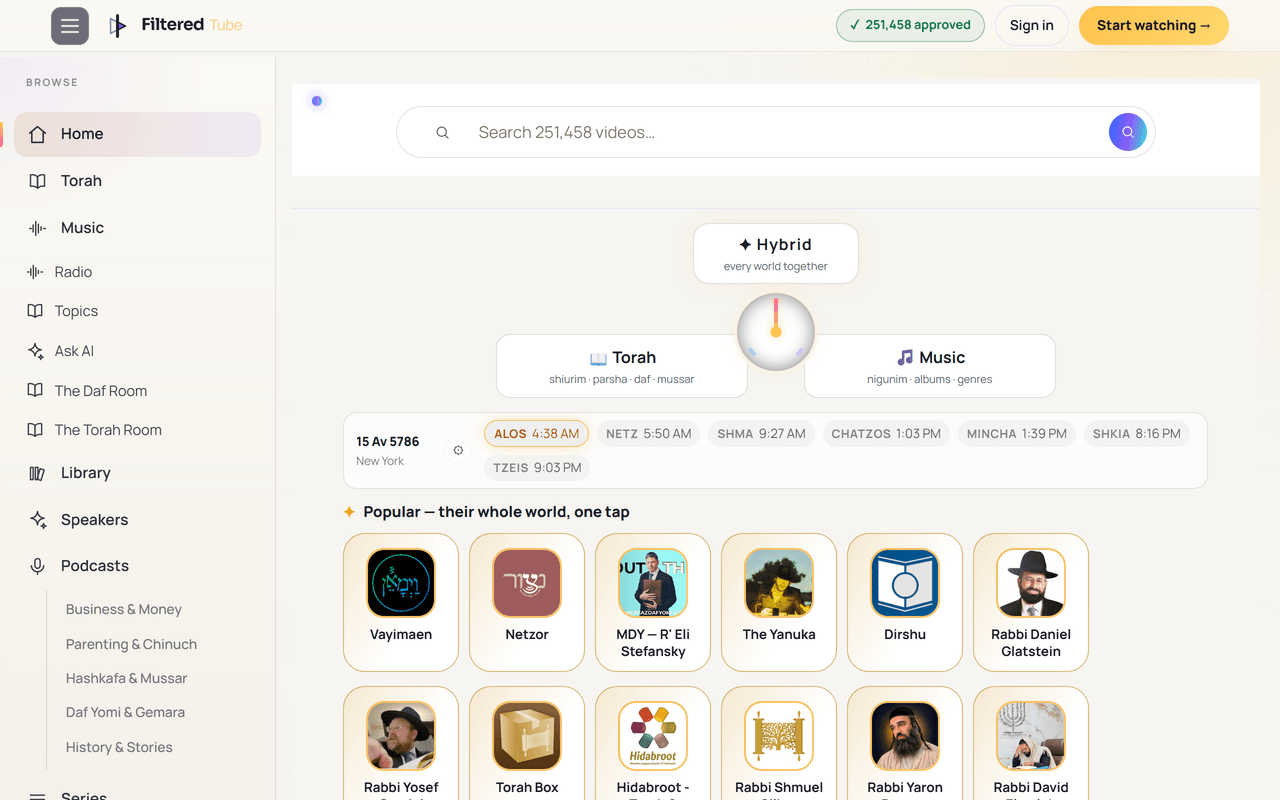
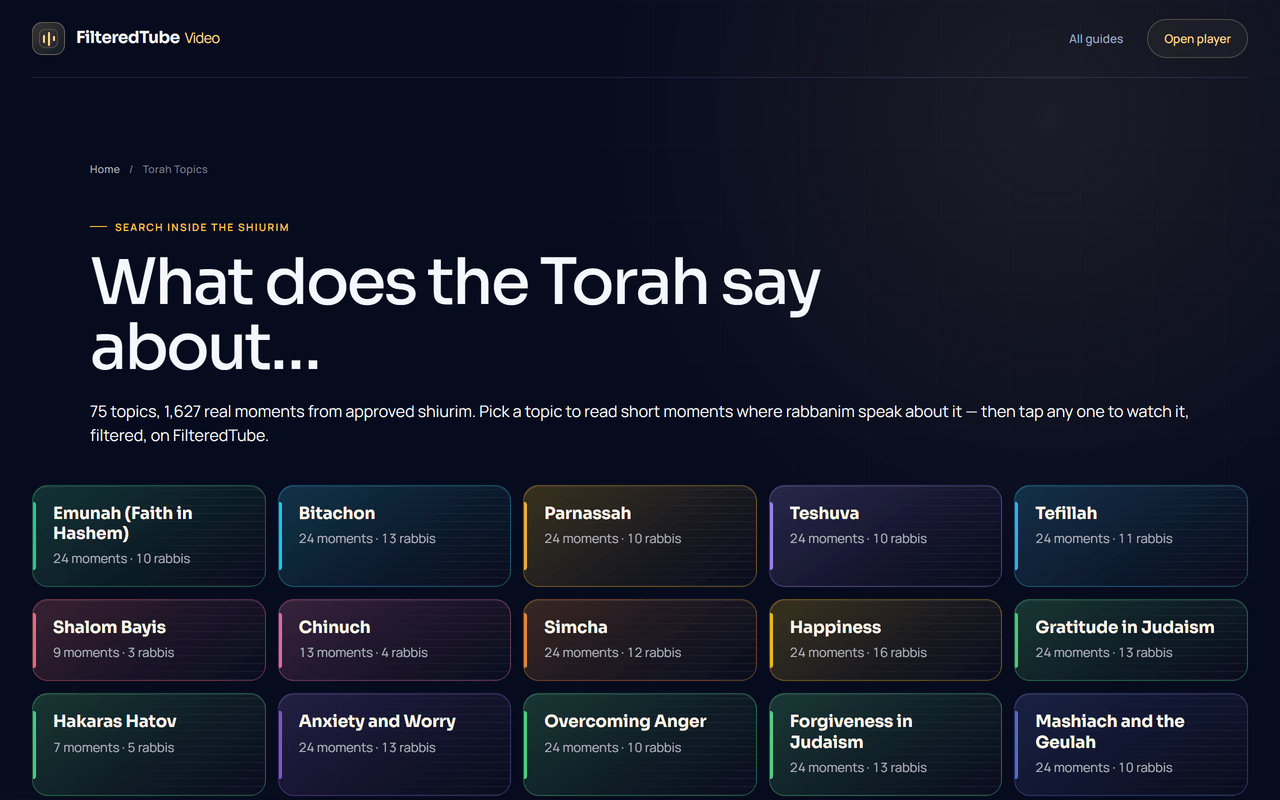
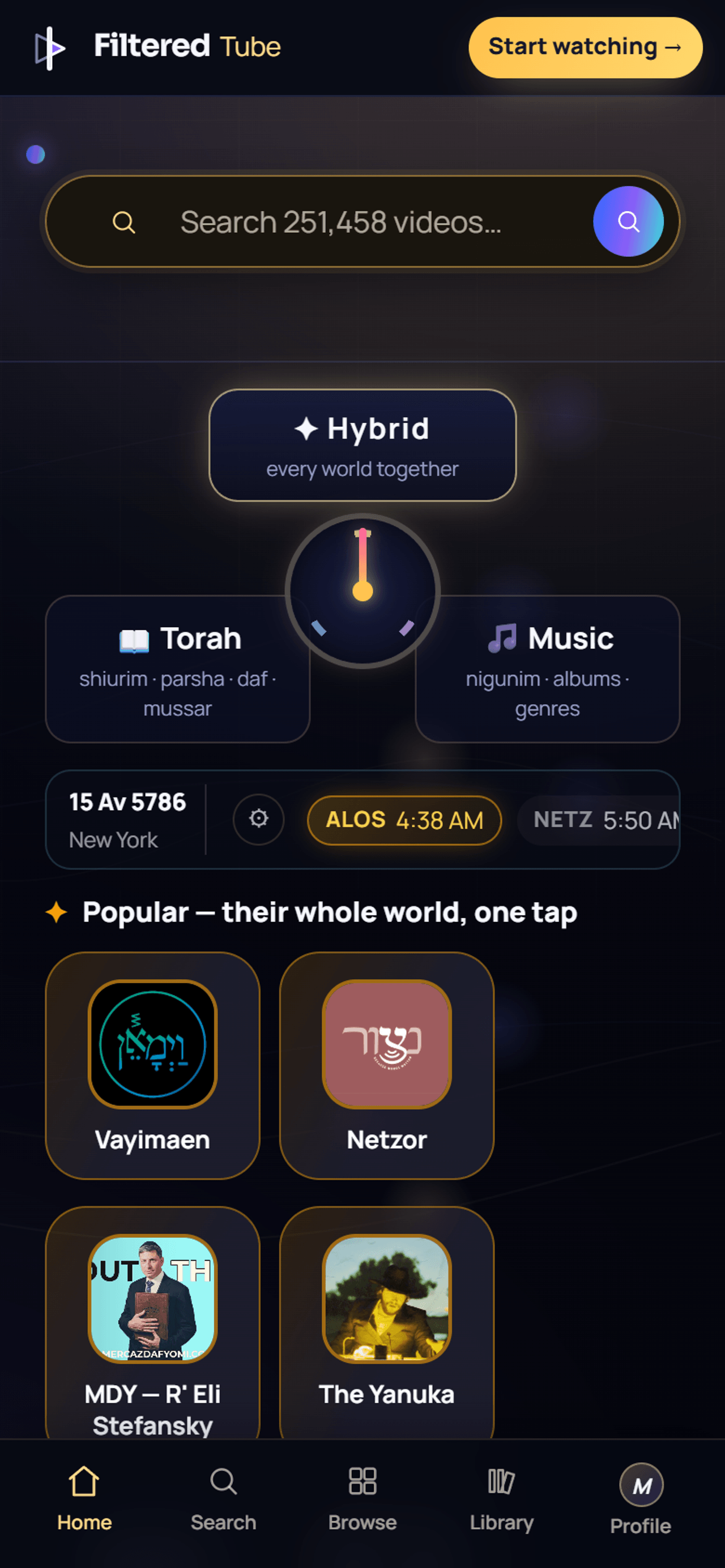
Real screenshots of the live platform — the approved player on desktop, in light mode, in the Torah library, and on a phone:
Frequently asked
What is a kosher YouTube?
The phrase is used for two opposite things. One is the ordinary open site with a filtering setting switched on — every video is still present, some are hidden, and the feed, search and comments continue as normal. The other is a separate library where the open site is not present at all, and a video only appears because it was judged against a written standard first. Lehallel is the second kind.
Is Lehallel a kosher YouTube app?
Yes. Lehallel is an approved-catalog streaming platform for Jewish families — 386,335 approved videos including 359,785 Torah classes, plus Jewish music and kids' videos — playable in any browser or as an app, with nothing unapproved able to play.
How is an approved library different from turning on Restricted Mode?
Restricted Mode hides some content inside the open site, but the feed, autoplay, comments and unfiltered search all remain, and whatever it misses gets through. An approved library inverts the default: nothing appears unless it passed review first. The failure changes from 'something bad slipped in' to 'something good is not in yet'.
Who decides what is kosher on the platform?
Every video is measured against one written standard — the same standard for every video, whoever uploaded it. Doubt does not open a video: it stays closed until a review says otherwise. Popularity does not approve a video, and the standard is not loosened to make the catalog look bigger.
Are there ads or comments?
No. There is no advertising from us, no comment sections, no community tabs and no suggested-video rail. When a video ends, nothing unapproved can follow it, because nothing unapproved exists in the library.
Does it work on a filtered phone?
That is much of the reason it exists. The library is its own place with its own door, so reaching a shiur or a song does not require opening the open internet.
Is there something for children specifically?
Yes — there is a kids' mode behind a PIN, so a child who opens the platform lands somewhere built for them rather than in the general catalog.
Can I start free?
Yes. You can open it and search the approved catalog today without a card.
Read next: filtered YouTube, every way to get it compared · why we built Lehallel · what “approved” actually means