This Week's Parsha: What Is Read This Shabbos, and Where to Learn It
This Shabbos, 10 October 2026 (29 Tishrei 5787), the parsha is Bereishis (Bereishis 1:1–6:8). The Shabbos after, 17 October 2026, it is Noach. Below: the next eight Shabbosos, how the yearly cycle works, and where to learn each parsha.

When Shabbos is yom tov
A few weeks a year have no ordinary parsha, because Shabbos falls on yom tov, and the reading is about the day instead. In 5787 the first such week was Shmini Atzeres, on Shabbos 3 October 2026. Here is what was read that week, from Hebcal's calendar:
| Day | What it is | The Torah reading |
|---|---|---|
| Friday 2 October (21 Tishrei) | Hoshana Rabbah, erev Shabbos and yom tov | The Sukkos reading for the day, Bamidbar 29:26–34 |
| Shabbos 3 October (22 Tishrei) | Shmini Atzeres | Devarim 14:22–16:17, maftir Bamidbar 29:35–30:1, haftara Melachim I 8:54–66, and Koheles. That night, Hebcal lists Devarim 33:1–17 for erev Simchas Torah |
| Sunday 4 October (23 Tishrei) | Simchas Torah | V'Zos Habracha to the end of the Torah (Devarim 33:1–34:12), then Bereishis 1:1–2:3, then Bamidbar 29:35–30:1; haftara Yehoshua 1:1–18 |
| Shabbos 10 October (29 Tishrei) | Parshas Bereishis | Bereishis 1:1–6:8; the haftara is Machar Chodesh, because Sunday is Rosh Chodesh |
In Eretz Yisrael Shmini Atzeres and Simchas Torah are one day. As Hebcal puts it, "In Israel and Reform Judaism, the holidays of Shemini Atzeret and Simchat Torah are combined into a single day." So in Eretz Yisrael the Torah was finished and begun again on Shabbos 3 October itself, and everyone reads Bereishis on 10 October.
How the yearly cycle works
The Torah is read through once a year, a portion each week. Wikipedia sums it up: "There are 54 parshas, or parashiyot in Hebrew, and the full cycle is read over the course of one Biblical year." The year ends and starts again on Simchas Torah. A Jewish year has fewer Shabbosos than parshiyos once the yamim tovim are counted, so in some weeks two parshiyos are read together, and in weeks like this one none is.
Double parshiyos in 5787
This year, 5787, is a leap year, with two months of Adar, so there are more Shabbosos to go around and fewer weeks with two parshiyos read together. According to Hebcal's calendar, outside Eretz Yisrael there are three: Chukas-Balak (17 July 2027), Matos-Masei (31 July 2027) and Nitzavim-Vayeilech (25 September 2027). In Eretz Yisrael there are only two, Matos-Masei and Nitzavim-Vayeilech, because Chukas and Balak are read on separate weeks there. In an ordinary year there are more: Vayakhel and Pekudei, Tazria and Metzora, Acharei Mos and Kedoshim, and Behar and Bechukosai are often joined. If you follow a parsha calendar on your phone or on a printed luach, it will show these doubles in advance.
There is also an old obligation that goes with the weekly cycle. The Shulchan Aruch (Orach Chaim 285:1), in Sefaria's community translation, says: "Even though each person hears the Torah reading each week in the public reading, we are obligated to read each parasha twice in the hebrew and once in the Aramaic targum." This is called shnayim mikra v'echad targum. How and when to do it is a good question for your rav.
The coming parshiyos
Here are the next eight Shabbosos, worked out from the Hebrew calendar each time this page is drawn, so you can plan the Shabbos table ahead. They are for outside Eretz Yisrael; in some years, for a few weeks after Pesach or Shavuos, Eretz Yisrael reads one parsha ahead.
| Shabbos | Hebrew date | Parsha | Reading |
|---|---|---|---|
| 10 October 2026 | 29 Tishrei | Bereishis | Bereishis 1:1–6:8 |
| 17 October 2026 | 6 Cheshvan | Noach | Bereishis 6:9–11:32 |
| 24 October 2026 | 13 Cheshvan | Lech Lecha | Bereishis 12:1–17:27 |
| 31 October 2026 | 20 Cheshvan | Vayeira | Bereishis 18:1–22:24 |
| 7 November 2026 | 27 Cheshvan | Chayei Sarah | Bereishis 23:1–25:18 |
| 14 November 2026 | 4 Kislev | Toldos | Bereishis 25:19–28:9 |
| 21 November 2026 | 11 Kislev | Vayeitzei | Bereishis 28:10–32:3 |
| 28 November 2026 | 18 Kislev | Vayishlach | Bereishis 32:4–36:43 |
Where to learn the parsha
People who search "this week's parsha" usually want one of three things: the text itself, a shiur on it, or something to say at the Shabbos table. Here is where each one lives.
- The text. Sefaria has Bereishis with translations and commentaries. LeHallel's Parsha room opens "the text, with ten meforshim on the page" through Read the parsha.
- A shiur. LeHallel keeps a shelf for every parsha. On 1 October 2026 its Every parsha list counted 39,622 approved shiurim placed on the 54 weeks, and 5,850 more on the parsha that do not name their week.
- Something for the table. A short shiur from a speaker your family likes, heard on Thursday, is the most reliable source of a dvar Torah on Friday night. The plan below builds it into the week.

A shiur sits on a parsha's shelf when its title or its label ties it to that parsha. That is a good guide, not a perfect one: the Bereishis page below includes a shiur that looks ahead to Noach and one on the whole of Sefer Bereishis. Read the title before you press play.
Bereishis: what the library holds
With the cycle starting again, here is how deep each parsha of Sefer Bereishis was on LeHallel on 1 October 2026. The whole sefer held 10,711 approved shiurim.
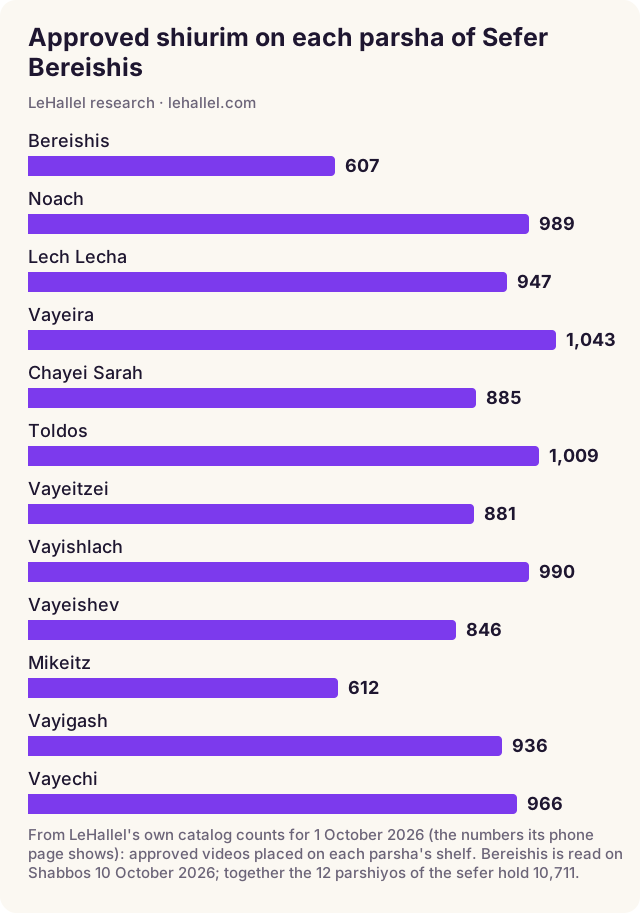
Parshas Bereishis itself held 607, fewer than most of the sefer. The speakers with the most approved shiurim on Bereishis were Rabbi Daniel Glatstein (80), Musayof Synagogue (62), Rabbi Shaked Bohadana (42) and Rabbi Alon Atia (41).

A week with the parsha: a plan for the table
Most families do not need more Torah content. They need the parsha to arrive at the table on Friday night without a scramble. This plan takes about fifteen minutes a day; change it to fit your week.
- Motzei Shabbos or Sunday: name it. Say the coming parsha out loud at the table or in the family chat. Children remember what they hear named.
- Sunday or Monday: the story. Read the parsha's main story in English or Hebrew, or play a short shiur on it in the car.
- Tuesday: one question. Each person picks one thing in the parsha that is surprising. Write the questions down.
- Wednesday: shnayim mikra. If you keep it, this is a good day to be halfway through. Ask your rav how.
- Thursday: one shiur. One shiur from a speaker your family likes, chosen from that parsha's shelf, not from a feed.
- Friday: one thought. Turn Tuesday's question and Thursday's shiur into one thought for the table. Let a child say it.
- Shabbos: ask back. At the meal, ask the children their Tuesday questions. The answers are usually better than ours.
Questions people ask
What is this week's parsha?
This Shabbos, 10 October 2026 (29 Tishrei 5787), the parsha is Bereishis (Bereishis 1:1–6:8). The Shabbos after, 17 October 2026, it is Noach.
When is Parshas Bereishis read in 2026?
On Shabbos 10 October 2026 (29 Tishrei 5787): Bereishis 1:1–6:8, with the haftara Machar Chodesh because Rosh Chodesh Cheshvan follows.
Why is there sometimes no parsha on Shabbos?
Because Shabbos is yom tov, and on yom tov the reading is about the day. On Shmini Atzeres 5787 (Shabbos 3 October 2026) it was Devarim 14:22–16:17, on the festivals, with Koheles.
Is the parsha the same in Eretz Yisrael?
From Bereishis through the winter, yes. When a yom tov day falls on Shabbos only outside Eretz Yisrael, Eretz Yisrael goes one parsha ahead for a few weeks; in 5787 that happens after Shavuos (Hebcal: Naso on 12 June 2027 in Eretz Yisrael, 19 June outside it, until Chukas-Balak on 17 July). Check a calendar like Hebcal for where you will be.
How many parshiyos are there?
Fifty-four, in five sefarim: Bereishis 12, Shemos 11, Vayikra 10, Bamidbar 10, Devarim 11.
Where can I find a parsha shiur for this week?
On the parsha's own shelf in an approved library such as LeHallel's Parsha room, or on the channel of a speaker you follow. On 1 October 2026 LeHallel counted 39,622 approved shiurim placed on the 54 parshiyos.
What is shnayim mikra v'echad targum?
Reading the week's parsha twice in the original and once in Targum, as the Shulchan Aruch (Orach Chaim 285:1) writes. Ask your rav how and when to do it.
How can I teach the parsha to my children?
Name it early in the week, read the story together, let each child find one question, and let a child say the thought at the table. The weekly plan above sets it out day by day.
Sources
- Hebcal, Parashat Bereshit (read 1 October 2026): "Next read on 10 Oct 2026 / 29 Tishrei 5787", Genesis 1:1–6:8.
- Hebcal, Simchat Torah 2026 (read 1 October 2026): the readings for Sunday 4 October 2026.
- Hebcal, Shmini Atzeret 2026 (read 1 October 2026): one day in Israel, two outside it.
- Hebcal, Torah readings (read 1 October 2026): the parshiyos and dates for 10 October to 28 November 2026.
- Wikipedia, Weekly Torah portion (read 1 October 2026).
- Shulchan Aruch, Orach Chaim 285:1, on Sefaria (Sefaria Community Translation, read 1 October 2026).
- LeHallel, the Parsha room and Every parsha, and Parshas Bereishis, opened in a real browser at iPhone size on 1 October 2026 (the pictures above).
- LeHallel's own catalog counts for 1 October 2026: approved shiurim per parsha, per sefer, and per speaker on Bereishis (the chart above).
- LeHallel, FAQ (read 1 October 2026): "No card is taken anywhere on this site"; every video "plays through YouTube's official player"; "YouTube may show its own ad on some of those videos."
- Hebcal, Shmini Atzeret 2026 and Hebcal's leyning for 2 to 4 October 2026 (read 1 October 2026): Bamidbar 29:26–34 on Hoshana Rabbah; Devarim 14:22–16:17, Bamidbar 29:35–30:1, Melachim I 8:54–66 and Koheles on Shmini Atzeres on Shabbos; Yehoshua 1:1–18 on Simchas Torah.